Leak Testing for Medical Devices: Ensuring Product Safety & Regulatory Compliance
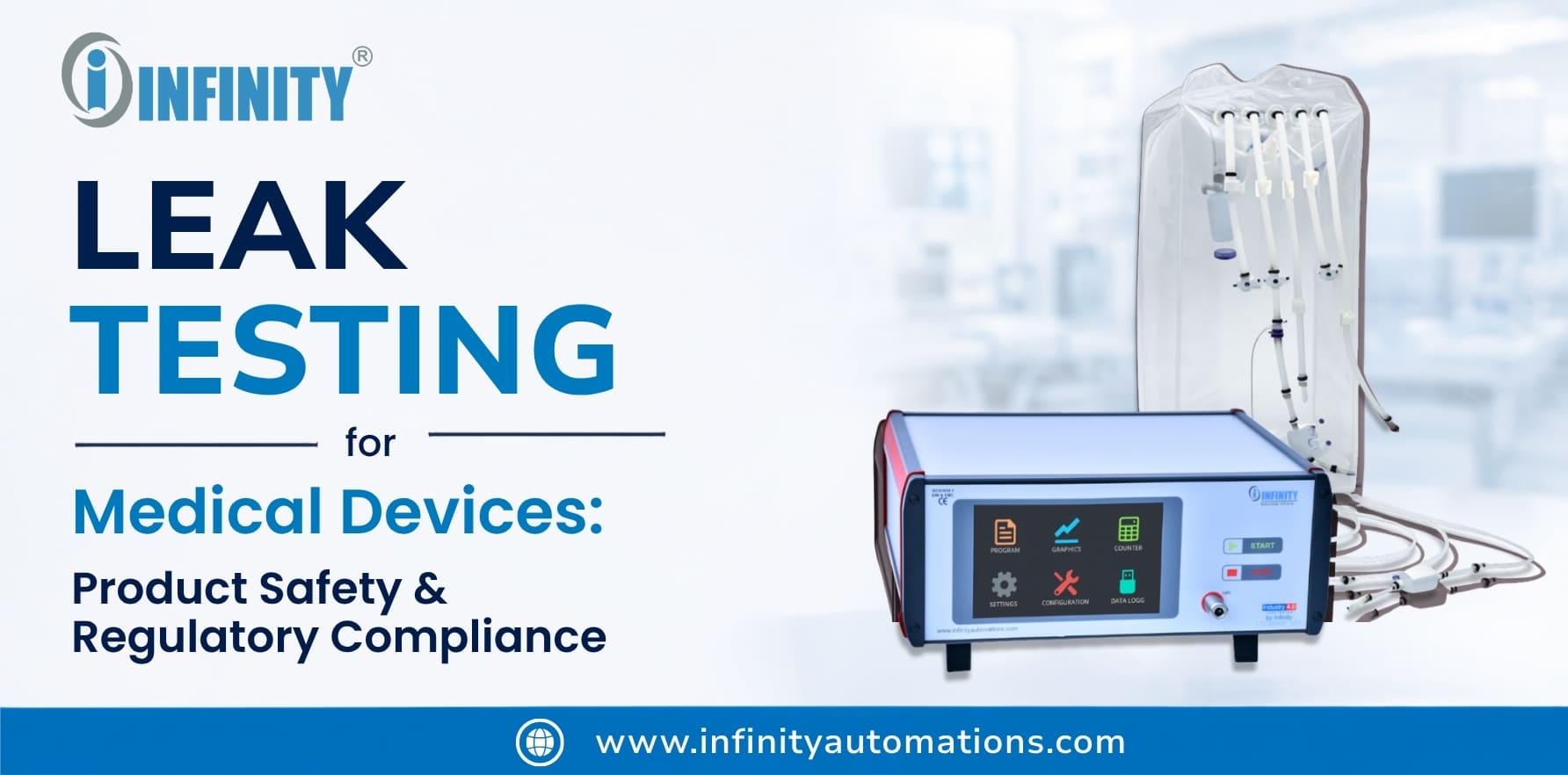
Leak Testing for Medical Devices is a quality inspection process used to detect leaks and verify the integrity of medical devices, components and sterile packaging. Depending on the application, manufacturers may use pressure decay, vacuum decay, differential pressure, flow testing or other appropriate methods.
Medical devices play a vital role in modern healthcare, supporting everything from diagnosis and drug delivery to surgery and life-saving treatments. Whether it is a catheter, IV set, infusion pump, respiratory device, implant, syringe, blood collection system, or diagnostic cartridge, every medical device must meet stringent quality and safety standards before reaching healthcare professionals and patients.
One of the most critical quality assurance processes in Medical Device Manufacturing is Leak Testing. Even microscopic leaks can compromise device performance, sterility, or packaging integrity, increasing the risk of contamination, treatment failure, product recalls, and regulatory non-compliance.
As global healthcare regulations become more stringent, manufacturers are increasingly adopting advanced Medical Device Leak Testing systems and Container Closure Integrity Testing (CCIT) technologies to verify product integrity throughout the manufacturing process.
This comprehensive guide explains why Leak Testing for Medical Devices is essential, explores common testing methods, discusses regulatory requirements, outlines validation strategies, and demonstrates how automated leak testing solutions improve product quality and patient safety.
Why Leak Testing is Critical for Medical Devices
Medical devices often come into direct contact with patients, medications, blood, sterile fluids, or sensitive biological materials. Any leak in the device itself or its sterile packaging can compromise patient safety and product performance.
Potential consequences of undetected leaks include loss of sterility, microbial contamination, fluid leakage, incorrect drug delivery, air ingress, device malfunction, product recalls, regulatory observations, increased warranty and replacement costs, and risks to patient health.
By implementing reliable Leak Testing for Medical Devices, manufacturers can identify defects before products are released to the market.
Understanding Medical Device Manufacturing
Medical devices are manufactured under highly controlled conditions to ensure safety, reliability, and regulatory compliance.
Typical manufacturing processes include:
- Injection molding
- Plastic welding
- Assembly
- Sterilization
- Packaging
- Leak testing
- Functional testing
- Visual inspection
- Final packaging
Leak testing is often performed at multiple stages to verify both product integrity and sterile packaging performance.
What is Medical Device Leak Testing?
Medical Device Leak Testing is a non-destructive or destructive quality inspection process used to detect leaks in medical products, components, and sterile packaging.
Depending on the product, testing may verify fluid tightness, air tightness, sterile barrier integrity, packaging integrity, seal quality, and assembly quality.
Modern leak testing systems provide highly accurate, repeatable, and automated inspection suitable for regulated medical manufacturing.
Medical Devices That Require Leak Testing
Leak testing is performed across a wide range of medical products.
Drug Delivery Devices
Examples include syringes, pre-filled syringes, auto-injectors, infusion pumps, and IV connectors.
Catheters
Manufacturers verify tube integrity, connector sealing, balloon leakage, and joint quality.
Blood Collection Systems
Leak testing ensures safe collection and transportation of blood samples.
Respiratory Devices
Applications include oxygen delivery systems, nebulizers, ventilator components, and breathing circuits.
Diagnostic Devices
Common products include test cartridges, microfluidic devices, and laboratory consumables.
Surgical Devices
Examples include endoscopic instruments, surgical tubing, and disposable sterile components.
Implantable Devices
Leak testing verifies long-term reliability for products such as drug reservoirs, implantable pumps, and certain electronic medical devices.
Explore single-use bag leak testing for medical applications
Leak Testing Methods for Medical Devices
The appropriate testing method depends on the device, material, production volume, and regulatory requirements.
Pressure Decay Testing
One of the most widely used deterministic methods.
Working Principle: The device is pressurized with clean air and isolated from the air source. Pressure loss is monitored over time.
Advantages: High accuracy, fast cycle times, non-destructive, easy automation, and excellent repeatability.
Applications include plastic components, medical tubing, fluid reservoirs, and housings.
Vacuum Decay Testing
The device or package is placed inside a vacuum chamber. Pressure changes indicate leakage.
Suitable for: Sterile packaging, pharmaceutical containers, and flexible medical packaging.
Differential Pressure Testing
Compares the pressure of a test part with a reference chamber.
Applications: Small-volume devices, precision leak detection, and high-sensitivity components.
Flow Testing
Measures airflow through components.
Suitable for: Filters, valves, medical tubing, and flow-control devices.
High Voltage Leak Detection (HVLD)
Primarily used for liquid-filled pharmaceutical containers.
Provides: High sensitivity, non-destructive testing, and automated inspection.
Medical Device Leak Testing Method Comparison
| Method | Basic Principle | Suitable Applications |
|---|---|---|
| Pressure Decay | Measures pressure loss in a sealed component | Medical components, tubing, reservoirs, housings |
| Vacuum Decay | Measures pressure changes under vacuum | Sterile packaging, pharmaceutical containers, flexible packaging |
| Differential Pressure | Compares test-part pressure with reference pressure | Small-volume and high-sensitivity components |
| Flow Testing | Measures airflow through a component | Filters, valves, tubing, flow-control devices |
| HVLD | Detects leakage using high-voltage-based inspection | Liquid-filled pharmaceutical containers |
Sterile Packaging & CCIT
Many medical devices are supplied in sterile packaging that must maintain sterility until the point of use.
Packaging formats include Tyvek® pouches, medical trays, blister packs, flexible pouches, peelable packaging, and sterile bags.
To verify packaging integrity, manufacturers increasingly use Container Closure Integrity Testing (CCIT).
Why CCIT is Important
CCIT detects microscopic leaks that may not be visible during visual inspection.
Benefits include: Improved sterile barrier assurance, higher sensitivity, objective measurements, better repeatability, and regulatory acceptance.
Medical Packaging Testing
Packaging validation includes multiple inspection methods.
Typical tests include Vacuum Decay Testing, Dye Ingress Testing, Seal Strength Testing, Burst Testing, Peel Testing, and Bubble Emission Testing.
Together, these methods verify that sterile packaging protects the product throughout transportation, storage, and use.
Validation Requirements
Leak testing systems should be validated before routine production.
Validation generally includes:
Installation Qualification (IQ)
Confirms equipment is installed correctly.
Operational Qualification (OQ)
Verifies operation across defined process limits.
Performance Qualification (PQ)
Demonstrates reliable performance during actual production.
Method Validation
Confirms the testing method can consistently detect leaks within specified limits.
Calibration
Pressure sensors, flow meters, and measuring instruments should be calibrated according to documented procedures.
Regulatory Standards
Medical device manufacturers operate under strict regulatory requirements.
ISO 13485
International quality management standard for medical device manufacturers. Focus areas include risk management, process validation, traceability, and documentation.
FDA 21 CFR Part 820
The FDA Quality System Regulation (transitioning to alignment with QMSR/ISO 13485) emphasizes design controls, process validation, production controls, and quality assurance for medical devices.
EU Medical Device Regulation (MDR)
Requires manufacturers to demonstrate product safety and performance through documented quality systems and validation activities.
ISO 11607
Applies to packaging for terminally sterilized medical devices. Covers package validation, seal integrity, transportation performance, and sterile barrier systems.
USP <1207>
Relevant when medical products incorporate pharmaceutical packaging requiring Container Closure Integrity Testing.
Benefits of Automated Leak Testing
Automated Leak Testing Machines provide significant advantages.
Detect manufacturing defects before shipment.
Reduce the risk of contamination and product failure.
Fast cycle times support high-volume manufacturing.
Automatic recording of test results, product IDs, batch numbers, operator information, and date and time.
Automation improves measurement consistency.
Early defect detection reduces rework and scrap.
Supports documentation required during audits and inspections.
Case Study: Leak Testing Improves Medical Device Quality
Customer Challenge: A manufacturer of sterile catheter assemblies experienced intermittent field failures due to undetected connector leaks. Manual inspection methods were unable to consistently identify small defects, leading to increased customer complaints and costly product investigations.
Solution: The manufacturer implemented a fully automated Pressure Decay Leak Testing Machine with custom fixtures, PLC-based controls, high-resolution pressure sensors, barcode integration, digital batch reporting, and automatic pass/fail sorting.
Results: Improved leak detection sensitivity, reduced false failures, increased production throughput, better process consistency, enhanced product traceability, reduced customer complaints, and stronger regulatory compliance.
Choosing the Right Leak Testing Solution
Before investing in a leak testing system, evaluate the following factors:
Product Type
Determine whether you are testing medical devices, packaging, sterile containers, or fluid systems.
Leak Sensitivity
Identify the smallest leak your application must detect.
Production Volume
Select equipment capable of supporting required cycle times.
Automation Requirements
Consider integration with robots, PLCs, MES systems, barcode scanners, and vision inspection systems.
Validation Support
Choose equipment that supports IQ, OQ, PQ, and documentation requirements.
Service & Technical Support
Reliable after-sales service and calibration support are essential for long-term performance.
Why Choose Infinity Automation Systems?
Infinity Automation Systems Private Limited develops advanced leak testing solutions for regulated manufacturing industries, including medical devices and pharmaceuticals.
Our solutions include:
- Pressure Decay Leak Testing Systems
- Vacuum Decay Testing Systems
- Automated Leak Testing Machines
- CCIT Equipment
- PLC & HMI-Based Automation
- Industry 4.0 Integration
- Custom Fixtures
- Digital Data Logging & Traceability
- Validation Support (IQ/OQ/PQ)
Our engineering team works closely with customers to deliver reliable, high-precision solutions tailored to specific medical device applications.
Looking for a Medical Device Leak Testing Solution?
Discuss your medical device, packaging or sterile manufacturing application with Infinity Automation Systems and identify the right leak testing, CCIT or automated inspection solution for your requirements.
Contact Our Technical Team → Explore CCIT Solutions →Conclusion
Leak Testing for Medical Devices is an essential quality assurance process that helps manufacturers deliver safe, reliable, and regulation-compliant products to the healthcare industry. From catheters and syringes to infusion systems, diagnostic devices, and sterile packaging, accurate Medical Device Leak Testing plays a critical role in preventing contamination, ensuring functional performance, and protecting patient safety.
Advanced Leak Testing Machines using technologies such as Pressure Decay Testing, Vacuum Decay Testing, Differential Pressure Testing, and Container Closure Integrity Testing (CCIT) provide the accuracy, repeatability, and automation required for today's highly regulated manufacturing environments. These systems not only improve product quality but also support validation, traceability, and compliance with standards such as ISO 13485, ISO 11607, FDA Quality System requirements, and EU MDR.
By investing in the right leak testing solution and implementing robust validation practices, medical device manufacturers can reduce defects, enhance operational efficiency, strengthen regulatory compliance, and build greater confidence in the safety and performance of their products.
Contact Infinity Automation Systems to discuss your medical device leak testing requirements.
Frequently Asked Questions (FAQs)
Leak testing ensures products remain safe, sterile, and functional by detecting defects before devices reach healthcare providers or patients.
Catheters, syringes, IV connectors, infusion pumps, respiratory devices, diagnostic cartridges, implantable devices, and many sterile medical products require leak testing.
Container Closure Integrity Testing (CCIT) verifies that sterile packaging maintains an effective barrier against contamination.
Pressure Decay Leak Testing is widely used because it offers high accuracy, repeatability, fast cycle times, and non-destructive testing.
Yes. Modern systems integrate with PLCs, robots, MES software, barcode scanners, vision systems, and digital quality management platforms.
Leak testing evaluates the integrity of medical devices, components, or systems, while Container Closure Integrity Testing (CCIT) specifically evaluates whether a container or package maintains an effective barrier against contamination and loss of product integrity.
Vacuum Decay Testing can be used for sterile packaging applications, while CCIT methods are selected according to the package design, required sensitivity, validation requirements, and applicable standards.
Validation demonstrates that the leak testing equipment and method consistently operate within defined requirements. It can include Installation Qualification (IQ), Operational Qualification (OQ), Performance Qualification (PQ), method validation, and calibration.
Manufacturers should evaluate the product type, required leak sensitivity, production volume, automation requirements, validation support, data requirements, and long-term technical and calibration support.
Yes. Automated systems can record test results, product IDs, batch numbers, operator information, and date and time, helping manufacturers maintain consistent production records and support quality documentation.