Bubble Point Test Explained: Principle, Procedure & Applications
Sterile pharmaceutical manufacturing depends on reliable filtration systems to ensure that injectable drugs, vaccines, biologics, ophthalmic products, and other sterile formulations remain free from microbial contamination. While sterilizing-grade membrane filters play a crucial role in removing microorganisms, simply installing a filter is not enough. Manufacturers must also verify that the filter remains intact and capable of performing its intended function.
This is where the Bubble Point Test becomes one of the most important Filter Integrity Testing methods in pharmaceutical manufacturing. It is a widely accepted, non-destructive test used to confirm the integrity of sterilizing-grade membrane filters before and after filtration.
The Bubble Point Test is recognized by pharmaceutical manufacturers and regulatory authorities worldwide because it provides a reliable indication that the membrane has not been damaged during handling, sterilization, installation, or production.
In this complete guide, you'll learn the working principle, equipment, test procedure, result interpretation, applications, advantages, common mistakes, and regulatory expectations surrounding Bubble Point Testing.
What is a Bubble Point Test?
A Bubble Point Test is a non-destructive Membrane Filter Test used to verify the integrity of sterilizing-grade membrane filters. The test determines the minimum gas pressure required to force liquid out of the largest pores of a fully wetted membrane, producing a continuous stream of bubbles.
The measured pressure, known as the Bubble Point, is directly related to the membrane's pore size. If the measured value falls within the validated specification provided by the filter manufacturer, the filter is considered intact and suitable for use.
Because the test evaluates the physical condition of the membrane rather than microbial retention directly, it serves as a validated indicator of filter performance.
Why is Bubble Point Testing Important?
Sterile filtration is often the final barrier preventing microorganisms from entering pharmaceutical products. A damaged membrane can compromise sterility, leading to contamination, product recalls, regulatory action, and potential risks to patient safety.
Routine Bubble Point Testing helps manufacturers:
- Verify membrane integrity
- Confirm sterilizing performance
- Detect damaged filters
- Prevent contamination
- Support aseptic manufacturing
- Reduce batch failures
- Meet regulatory requirements
- Maintain product quality
For these reasons, the Bubble Point Test is considered a critical quality control step in pharmaceutical manufacturing.
Principle of the Bubble Point Test
The Bubble Point Test is based on the relationship between surface tension, pore size, and gas pressure.
When a membrane filter is completely wetted with a suitable liquid, the liquid fills every pore. As compressed gas is applied to one side of the membrane, pressure gradually increases.
Initially, gas cannot pass through because the liquid blocks the pores.
As pressure continues to rise:
- Smaller pores remain filled with liquid.
- The largest pore empties first.
- Gas begins passing through that pore.
- A continuous stream of bubbles appears.
The pressure at which this continuous bubbling begins is called the Bubble Point Pressure.
A membrane with smaller pores requires higher pressure to produce bubbles, while larger pores produce bubbles at lower pressures.
This relationship allows manufacturers to verify that the membrane remains within its validated pore size specification.
Equipment Required for Bubble Point Testing
Modern pharmaceutical facilities use dedicated integrity testing instruments to perform Bubble Point Testing accurately and consistently.
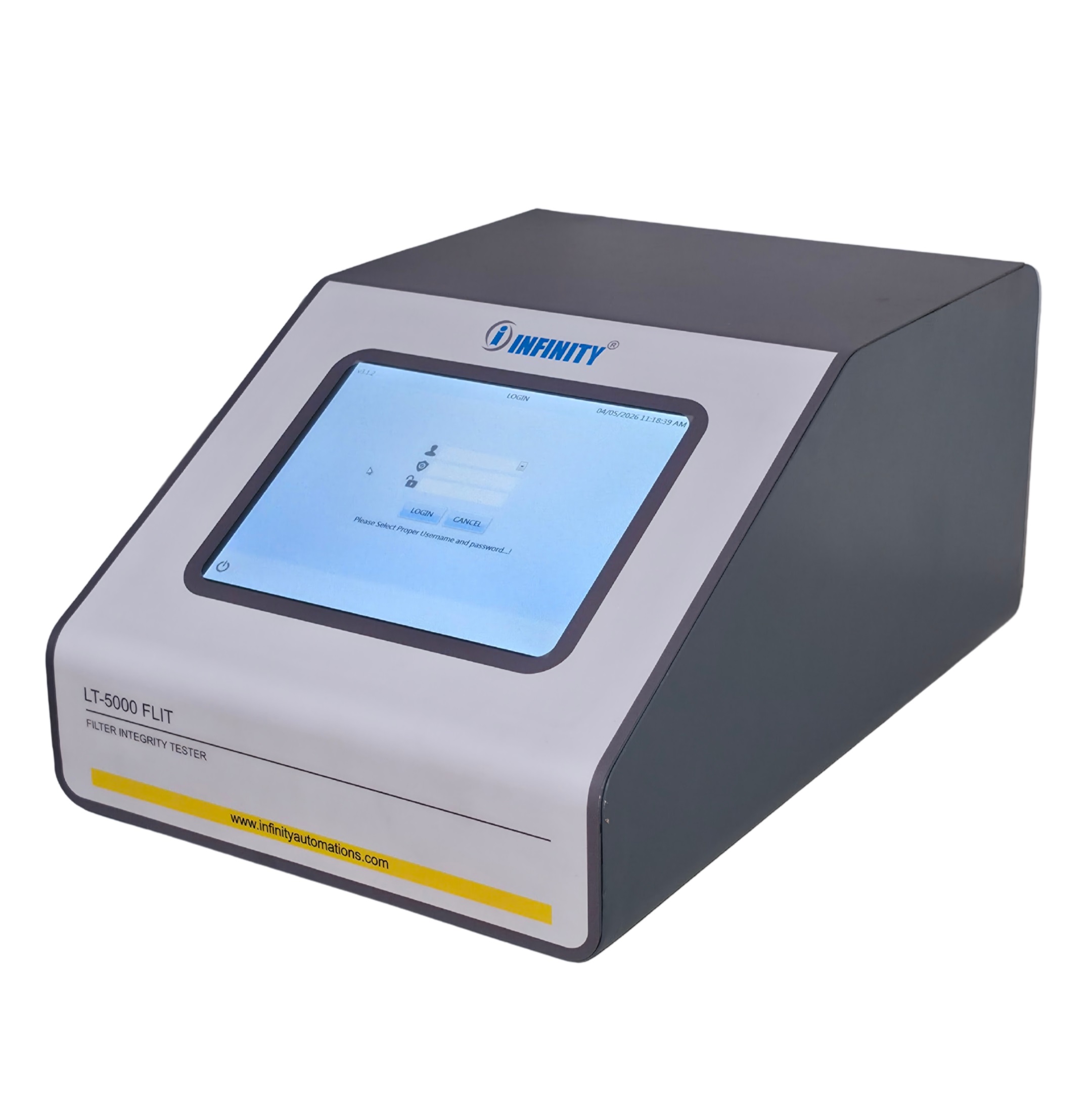
Automated instrument that controls pressure, measures airflow, and records results.
Typically clean compressed air, nitrogen, or other approved inert gases. The gas must be clean, dry, and oil-free.
The membrane must be completely wetted. Common liquids include Purified Water, Water for Injection (WFI), Isopropyl Alcohol (IPA) mixtures (for hydrophobic filters), or manufacturer-recommended fluids.
Controls gas pressure during testing.
High-accuracy sensors continuously monitor applied pressure.
Modern testers automatically record bubble point value, test pressure, operator ID, filter identification, date and time, and pass/fail status.
Step-by-Step Bubble Point Test Procedure
Although procedures vary depending on the filter manufacturer, the overall process is generally similar.
Step 1: Install the Filter
Install the sterilizing-grade membrane filter according to manufacturer instructions. Ensure all fittings are secure and leak-free.
Step 2: Wet the Membrane
Completely wet the membrane using the recommended wetting fluid. Incomplete wetting is one of the most common causes of inaccurate results.
Step 3: Connect the Integrity Tester
Attach the filter housing to the integrity testing instrument. Verify all connections before starting the test.
Step 4: Apply Compressed Gas
The tester gradually increases gas pressure while monitoring airflow through the membrane.
Step 5: Detect the Bubble Point
When the largest membrane pore empties, a continuous stream of bubbles forms. The instrument automatically records the corresponding pressure.
Step 6: Compare Results
Measured values are compared with validated acceptance limits supplied by the filter manufacturer.
Step 7: Generate Test Report
Modern systems automatically generate electronic reports containing test results, Filter ID, Equipment ID, Operator information, Batch details, and Pass/fail decision.
Interpretation of Test Results
Correct interpretation is essential for maintaining pharmaceutical quality.
Pass
The measured Bubble Point value falls within the validated specification. This indicates membrane integrity is maintained, filter is suitable for sterile filtration, and no significant membrane damage is detected.
Fail
A Bubble Point value below specification may indicate a damaged membrane, torn filter, incorrect wetting, seal leakage, or incorrect test setup. Failed filters should not be used for production until the root cause has been identified and resolved.
Applications of Bubble Point Testing
Bubble Point Testing is used throughout pharmaceutical and biotechnology manufacturing.
- Injectable Drug Manufacturing: Verifies sterilizing filters used before aseptic filling.
- Vaccine Production: Ensures membrane integrity during sterile filtration.
- Biopharmaceutical Manufacturing: Used in filtration of monoclonal antibodies, recombinant proteins, and cell culture media.
- Ophthalmic Products: Maintains sterility of eye drops and ophthalmic solutions.
- Medical Device Manufacturing: Used during sterile fluid processing.
- Laboratory Validation: Supports filter qualification, process validation, and method development.
Advantages of the Bubble Point Test
The Bubble Point Test offers several important benefits.
The filter remains usable after testing when performed correctly.
Provides consistent verification of membrane integrity.
Recognized by regulatory authorities and filter manufacturers worldwide.
Modern integrity testers perform Bubble Point Testing automatically.
Helps demonstrate compliance with pharmaceutical GMP requirements.
Automated systems provide highly reproducible results.
Can be integrated into standard manufacturing workflows.
Common Mistakes During Bubble Point Testing
Even validated procedures can produce incorrect results if testing is not performed properly.
- Incomplete Membrane Wetting: Dry areas of the membrane significantly affect bubble point values.
- Wrong Wetting Fluid: Using an incorrect liquid changes surface tension and affects measured pressure.
- Leaking Connections: Leaks in fittings or seals may produce false failures.
- Incorrect Pressure Ramp: Pressure must increase according to validated procedures.
- Uncalibrated Equipment: Pressure sensors require regular calibration.
- Contaminated Gas Supply: Oil or moisture contamination may influence test performance.
- Incorrect Filter Installation: Improper installation may cause bypass leakage rather than membrane failure.
Bubble Point Test vs Other Filter Integrity Tests
| Test Method | Working Principle | Non-Destructive | Typical Application |
|---|---|---|---|
| Bubble Point Test | Gas displaces liquid from largest pore | Yes | Sterilizing filters |
| Diffusion Test | Measures gas diffusion below bubble point | Yes | Routine production |
| Pressure Hold Test | Measures pressure decay over time | Yes | Cartridge filters |
Each method provides valuable information, and many pharmaceutical manufacturers use multiple integrity tests depending on the application.
Regulatory Compliance
Pharmaceutical manufacturers are expected to validate sterilizing filters and verify their integrity.
- FDA Guidance: The U.S. FDA expects manufacturers to demonstrate filter integrity through validated testing procedures before or after use as appropriate.
- EU GMP Annex 1: Recommends integrity testing of sterilizing filters before use whenever practical and always after use unless scientifically justified otherwise.
- USP Guidance: Supports validated integrity testing as an important component of sterile manufacturing and contamination control.
- Good Documentation Practices: Manufacturers should maintain complete records of test results, equipment calibration, filter identification, batch information, operator details, deviations, and corrective actions.
Best Practices for Bubble Point Testing
Implementing standardized procedures improves accuracy and regulatory compliance.
- Use Manufacturer Specifications: Always compare measured values with validated filter specifications.
- Calibrate Equipment Regularly: Routine calibration ensures reliable pressure measurements.
- Train Personnel: Operators should understand membrane wetting, equipment operation, acceptance criteria, and documentation requirements.
- Follow Standard Operating Procedures: Use validated SOPs for every integrity test.
- Maintain Traceability: Electronic batch records simplify inspections and investigations.
- Perform Routine Preventive Maintenance: Well-maintained integrity testers produce more reliable results.
Future Trends in Filter Integrity Testing
Pharmaceutical manufacturing continues to embrace digital transformation.
- Fully automated integrity testing
- Electronic batch records
- Cloud-based quality management
- AI-assisted trend analysis
- IoT-enabled monitoring
- Predictive maintenance
- Digital validation documentation
- Remote diagnostics
These innovations improve efficiency while strengthening data integrity and regulatory compliance.
Need a Reliable Filter Integrity Tester?
Contact Infinity Automation Systems today to discuss your filter integrity testing requirements. Our engineering team will help you select the right solution for your pharmaceutical manufacturing needs.
Contact Infinity Automation Systems →Conclusion
The Bubble Point Test is one of the most trusted and widely used methods of Filter Integrity Testing in pharmaceutical and biotechnology manufacturing. By verifying the integrity of sterilizing-grade membrane filters, it helps ensure that critical filtration processes continue to provide effective microbial retention, protecting product sterility and patient safety.
Its non-destructive nature, excellent repeatability, and widespread regulatory acceptance make Bubble Point Testing an essential part of sterile manufacturing quality systems. When combined with proper membrane wetting, validated procedures, calibrated equipment, and comprehensive documentation, the test provides reliable assurance that filters remain suitable for use throughout the production process.
As pharmaceutical manufacturing continues to adopt Industry 4.0 technologies, automated Sterile Filter Tests and advanced Membrane Filter Test systems will further improve testing accuracy, data integrity, and operational efficiency. Implementing a robust Bubble Point Testing program not only supports regulatory compliance but also strengthens overall product quality and manufacturing confidence.
Frequently Asked Questions (FAQs)
A Bubble Point Test is a non-destructive filter integrity test used to verify that a sterilizing-grade membrane filter remains intact and capable of performing sterile filtration.
It confirms membrane integrity before or after filtration, helping prevent microbial contamination and ensuring product sterility.
No. When performed correctly using validated procedures, the Bubble Point Test is a non-destructive method.
Typical equipment includes a filter integrity tester, compressed gas supply, pressure sensors, pressure regulators, wetting fluid, and data recording system.
Bubble Point Testing is widely used in pharmaceutical manufacturing, biotechnology, vaccine production, medical device manufacturing, laboratory validation, and sterile processing applications.