Leak Testing Machine for Pharmaceutical Industry
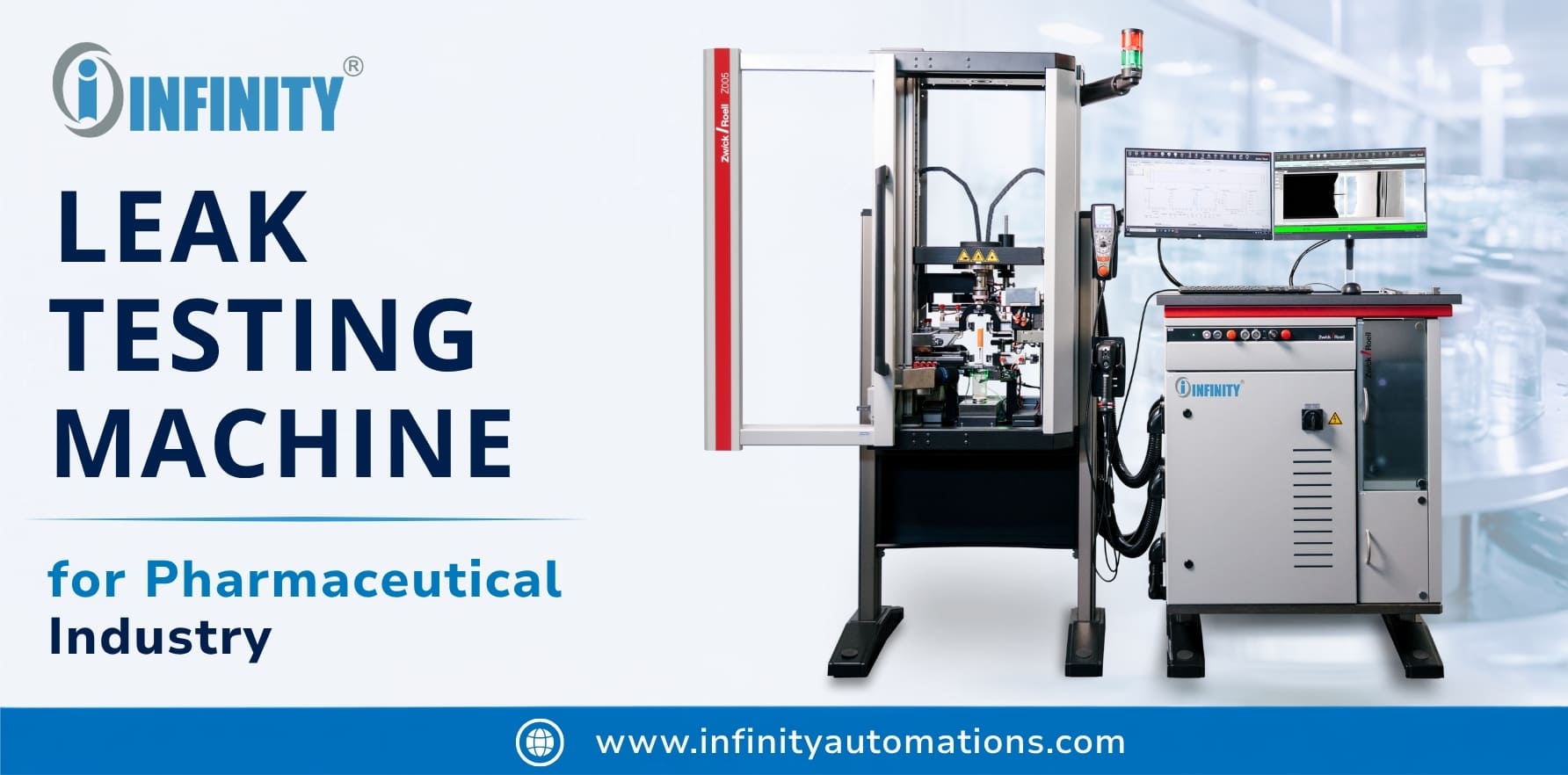
A Leak Testing Machine for the Pharmaceutical Industry is an automated inspection system used to verify the integrity of pharmaceutical containers, packaging and assemblies by detecting leaks that could compromise sterility or product quality.
The pharmaceutical industry operates under some of the world's most stringent quality and regulatory standards. Every sterile injectable drug, vaccine, biologic, ophthalmic solution, infusion bag, pre-filled syringe, vial, cartridge, and ampoule must remain free from contamination throughout its manufacturing process, transportation, storage, and shelf life.
Even microscopic leaks in pharmaceutical packaging can compromise sterility, allowing microorganisms, oxygen, moisture, or other contaminants to enter the container. Such defects can reduce product efficacy, lead to costly recalls, trigger regulatory observations, and, most importantly, endanger patient safety.
To prevent these risks, manufacturers rely on advanced Leak Testing Machines for Pharmaceutical Industry applications. These systems use validated technologies such as Container Closure Integrity Testing (CCIT), Pressure Decay Testing, Vacuum Decay Testing, and other deterministic methods to verify the integrity of pharmaceutical packaging before products are released to the market.
This comprehensive guide explains the importance of Pharmaceutical Leak Testing, explores the most widely used leak testing technologies, discusses validation and regulatory requirements, and highlights how automated leak testing systems improve quality, compliance, and manufacturing efficiency.
Why Leak Testing is Critical in Pharmaceutical Manufacturing
Sterile pharmaceutical products must maintain container integrity from the moment they are filled until they are administered to the patient. Even an extremely small leak can compromise the sterile barrier, resulting in contamination or product degradation.
Potential consequences of undetected leaks include microbial contamination, loss of sterility, moisture ingress, oxygen ingress, product degradation, reduced shelf life, product recalls, regulatory non-compliance, financial losses, and risks to patient safety.
A reliable Leak Testing Machine enables manufacturers to detect these defects before products leave the production facility.
What is a Leak Testing Machine?
A Leak Testing Machine is an automated inspection system designed to evaluate the integrity of pharmaceutical containers, packaging, and assemblies by detecting leaks that may compromise sterility or product quality.
Modern systems can inspect glass vials, ampoules, pre-filled syringes, Blow-Fill-Seal (BFS) containers, cartridges, IV bags, plastic pharmaceutical bottles, medical packaging, and flexible sterile packaging.
These machines provide fast, repeatable, and highly sensitive inspection suitable for both laboratory validation and production environments.
Pharmaceutical Products That Require Leak Testing
Leak testing is performed on a wide variety of pharmaceutical products.
Injectable Drugs
Sterility must be maintained throughout the product lifecycle.
Vaccines
Container integrity protects sensitive biological formulations from contamination and degradation.
Biologics
Biopharmaceutical products require highly reliable sterile packaging.
Ophthalmic Solutions
Eye care products demand sterile packaging to ensure patient safety.
IV Bags
Leak testing verifies that infusion bags maintain seal integrity during storage and transport.
Pre-filled Syringes
Testing ensures proper sealing and prevents contamination or leakage.
Cartridges
Commonly used in pen injectors and drug delivery systems.
Blow-Fill-Seal (BFS) Containers
Require validated leak testing to verify packaging integrity after manufacturing.
Understanding Sterile Packaging
Sterile packaging serves as the final protective barrier between the pharmaceutical product and the external environment.
Common packaging systems include glass vials, rubber stoppers, aluminum crimp seals, ampoules, plastic containers, flexible infusion bags, cartridges, and pre-filled syringes.
Every packaging system must be capable of maintaining sterility throughout its intended shelf life.
Container Closure Integrity Testing (CCIT)
Container Closure Integrity Testing (CCIT) is one of the most important quality assurance processes in pharmaceutical manufacturing.
CCIT verifies that a package maintains a sterile barrier by detecting microscopic leaks that could compromise product integrity.
Compared with traditional methods, deterministic CCIT technologies provide higher sensitivity, objective measurements, excellent repeatability, non-destructive testing, automated inspection, and regulatory acceptance.
Leak Testing Methods Used in Pharmaceutical Manufacturing
Different packaging systems require different testing technologies.
Vacuum Decay Testing
One of the most widely accepted deterministic CCIT methods.
Working Principle: The package is placed inside a vacuum chamber. Any leak causes measurable pressure changes, allowing the system to determine package integrity.
Advantages: Non-destructive, high sensitivity, excellent repeatability, and suitable for automation.
Applications: Vials, BFS containers, IV bags, plastic bottles, and cartridges.
Pressure Decay Testing
Pressure Decay Testing measures pressure loss from a sealed package after pressurization.
Benefits: High accuracy, fast cycle times, easy automation, and reliable repeatability.
Applications: Rigid pharmaceutical containers, medical devices, and plastic packaging.
High Voltage Leak Detection (HVLD)
Used primarily for liquid-filled pharmaceutical products.
Advantages: Extremely sensitive, non-destructive, high-speed inspection, and suitable for production lines.
Applications: Injectable drugs, ampoules, pre-filled syringes, and BFS containers.
Helium Leak Testing
Uses helium tracer gas to detect extremely small leaks.
Typically used for: Validation studies, high-value pharmaceutical products, and specialized packaging systems.
Dye Ingress Test
A traditional probabilistic method in which packages are immersed in dye under vacuum or pressure.
Advantages: Simple and low equipment cost.
Limitations: Destructive, lower sensitivity, and operator dependent.
Pharmaceutical Leak Testing Method Comparison
| Method | Principle | Key Advantages | Applications |
|---|---|---|---|
| Vacuum Decay | Measures pressure changes inside a vacuum chamber | Non-destructive, sensitive, repeatable | Vials, BFS, IV bags, bottles, cartridges |
| Pressure Decay | Measures pressure loss after pressurization | Accurate, fast, automatable | Rigid pharmaceutical containers, medical devices, plastic packaging |
| HVLD | Detects leaks using high-voltage inspection | Highly sensitive, fast, non-destructive | Injectable drugs, ampoules, pre-filled syringes, BFS |
| Helium Leak Testing | Uses helium tracer gas | Extremely sensitive | Validation, high-value products, specialized packaging |
| Dye Ingress | Detects dye penetration under vacuum/pressure | Simple, lower equipment cost | Traditional probabilistic testing |
Validation Requirements
Leak testing systems should undergo comprehensive validation before production use.
Installation Qualification (IQ)
Verifies that equipment is installed according to specifications.
Operational Qualification (OQ)
Confirms that the machine performs correctly throughout its operating range.
Performance Qualification (PQ)
Demonstrates consistent performance during actual production.
Method Validation
Confirms that the selected leak testing method reliably detects leaks within specified acceptance limits.
Calibration
Routine calibration ensures continued measurement accuracy.
Regulatory Standards
Pharmaceutical manufacturers must comply with strict global regulations.
USP <1207>
USP <1207> strongly recommends deterministic Container Closure Integrity Testing methods due to their superior sensitivity and repeatability.
FDA Guidance
The U.S. Food and Drug Administration expects scientifically sound, validated methods for verifying container closure integrity and maintaining sterile product quality.
EU GMP Annex 1
Annex 1 requires manufacturers to implement contamination control strategies and validate packaging systems used for sterile medicinal products.
ICH Guidelines
ICH quality guidelines emphasize maintaining product quality and package integrity throughout the product lifecycle.
ISO Quality Standards
Manufacturers commonly implement ISO-based quality management systems to support pharmaceutical production and continuous improvement.
Benefits of Automated Leak Testing Machines
Automated Leak Testing Machines provide numerous advantages over manual inspection.
Detect defects before products reach patients.
Protect against microbial contamination.
Fast cycle times support high-volume pharmaceutical manufacturing.
Most deterministic methods preserve product usability after testing.
Automatic recording of batch number, product ID, test parameters, leak rate, operator ID, date and time, and pass/fail results.
Automation minimizes operator dependency and improves consistency.
Supports audit readiness through comprehensive electronic records.
Industry Case Study
Customer Challenge: A pharmaceutical manufacturer producing sterile injectable products experienced inconsistent results with manual dye ingress testing. The method was destructive, time-consuming, and lacked the sensitivity required for routine quality assurance.
Solution: The manufacturer implemented an automated Vacuum Decay Leak Testing Machine integrated with PLC-based controls, high-resolution pressure sensors, barcode tracking, electronic batch reporting, automatic pass/fail sorting, and 21 CFR Part 11–compatible data management (where required).
Results: Improved defect detection, reduced testing time, non-destructive inspection, better production efficiency, enhanced regulatory compliance, complete product traceability, and reduced batch rejection.
How to Choose the Right Leak Testing Method for Pharmaceutical Packaging
Selecting the right Leak Testing Machine for Pharmaceutical Industry depends on several factors.
- Vacuum Decay: Suitable for vials, BFS containers, IV bags, plastic bottles, and cartridges.
- Pressure Decay: Suitable for rigid pharmaceutical containers and plastic packaging.
- HVLD: Suitable for liquid-filled pharmaceutical products.
- Helium Leak Testing: Suitable for validation and highly sensitive applications.
- Dye Ingress: Suitable for traditional probabilistic testing.
Choosing the Right Leak Testing Machine
Selecting the right Leak Testing Machine for Pharmaceutical Industry depends on several factors.
Product Type
Consider whether the application involves vials, syringes, ampoules, BFS containers, IV bags, or cartridges.
Packaging Material
Glass, plastic, elastomeric closures, and flexible packaging may require different testing technologies.
Required Sensitivity
Select a method capable of detecting leaks within your validated acceptance criteria.
Production Volume
High-volume production requires fast, automated inspection systems.
Regulatory Requirements
Ensure the solution supports validation, electronic records, audit trails, and applicable regulatory expectations.
Automation Integration
Modern systems can integrate with PLCs, MES, SCADA, vision inspection, robotic handling, and serialization systems.
Why Choose Infinity Automation Systems?
Infinity Automation Systems Private Limited provides advanced leak testing and inspection solutions for pharmaceutical, biotechnology, and medical device manufacturers.
Our solutions include:
- Vacuum Decay Leak Testing Machines
- Pressure Decay Leak Testing Systems
- Container Closure Integrity Testing (CCIT)
- Automated Inspection Stations
- PLC & HMI-Based Controls
- Industry 4.0 Integration
- Digital Data Logging
- Custom Fixtures
- Validation Support (IQ/OQ/PQ)
Our systems are engineered to improve product quality, manufacturing efficiency, and regulatory compliance while supporting modern pharmaceutical production environments.
Looking for a Pharmaceutical Leak Testing Solution?
Discuss your pharmaceutical packaging, CCIT, vial, syringe, ampoule or sterile manufacturing application with Infinity Automation Systems and identify the right leak testing solution for your production and validation requirements.
Contact Our Technical Team → Explore CCIT Solutions →Conclusion
A Leak Testing Machine for Pharmaceutical Industry is a critical investment for manufacturers committed to producing safe, sterile, and high-quality pharmaceutical products. By implementing advanced Pharmaceutical Leak Testing technologies such as Container Closure Integrity Testing (CCIT), Pressure Decay Testing, and Vacuum Decay Testing, organizations can detect microscopic leaks that may otherwise compromise sterility, product stability, and patient safety.
Automated leak testing solutions provide high sensitivity, non-destructive inspection, digital traceability, and seamless integration with modern pharmaceutical manufacturing systems. Combined with robust validation practices, regulatory compliance, and electronic documentation, these systems help manufacturers meet global quality standards while improving operational efficiency and reducing product risk.
As pharmaceutical production continues to evolve with automation and Industry 4.0 technologies, advanced leak testing solutions will remain an essential part of sterile manufacturing, ensuring every product delivered to healthcare providers and patients meets the highest standards of quality, integrity, and safety.
Frequently Asked Questions (FAQs)
Leak testing verifies that pharmaceutical packaging maintains sterility and protects products from contamination, moisture, and oxygen ingress.
Container Closure Integrity Testing (CCIT) evaluates whether a pharmaceutical package maintains an effective sterile barrier throughout its shelf life.
Vacuum Decay Testing and Pressure Decay Testing are among the most widely used deterministic methods due to their accuracy, repeatability, and non-destructive nature.
Injectable drugs, vaccines, biologics, IV bags, pre-filled syringes, cartridges, ampoules, and BFS containers commonly undergo leak testing.
Yes. Modern systems integrate with PLCs, MES platforms, robotic handling systems, barcode readers, and electronic batch record software.
Deterministic methods use measurable physical principles to detect leaks and can provide repeatable, objective results. The article identifies Vacuum Decay, Pressure Decay and other technologies as deterministic methods, while Dye Ingress is described as a traditional probabilistic method.
Common applications include glass vials, ampoules, pre-filled syringes, Blow-Fill-Seal containers, cartridges, IV bags, plastic pharmaceutical bottles and flexible sterile packaging.
Vacuum Decay Testing is a non-destructive deterministic method that can provide high sensitivity, repeatability and automation. The article identifies applications including vials, BFS containers, IV bags, plastic bottles and cartridges.
The article identifies Installation Qualification (IQ), Operational Qualification (OQ), Performance Qualification (PQ), method validation and calibration as key validation activities for leak testing systems.
Manufacturers should consider the product type, packaging material, required leak sensitivity, production volume, regulatory requirements and automation-integration requirements.