Air Leak Tester vs Leak Testing Machine: What's the Difference?
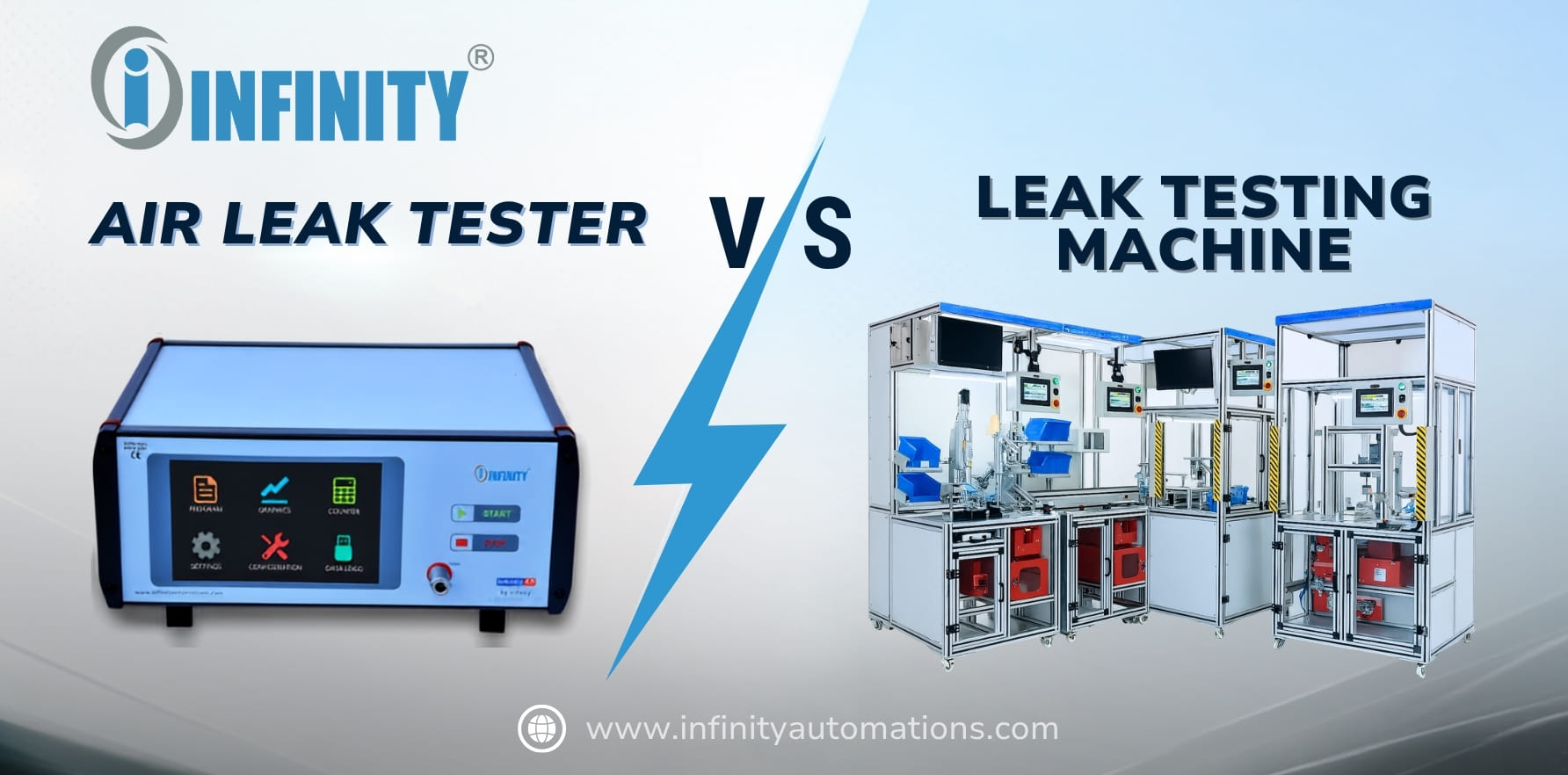
An Air Leak Tester is a precision instrument used to measure leaks, while a Leak Testing Machine is a complete industrial testing system that combines the tester with fixtures, pneumatic controls, PLC/HMI systems and automation. An Air Leak Tester is generally suited to standalone or lower-volume testing, whereas a Leak Testing Machine is designed for automated production environments.
When researching leak detection solutions for manufacturing, many engineers, procurement teams, and business owners encounter terms like Air Leak Tester, Leak Testing Machine, Air Leak Testing Machine, and Leak Testing Equipment. These terms are often used interchangeably, leading to confusion during product selection and purchasing.
Are they the same machine? Is an Air Leak Tester different from a Leak Testing Machine? Which one is better for industrial applications?
The answer depends on the application and the level of automation required. In many cases, an Air Leak Tester is a core testing instrument, while a Leak Testing Machine is a complete automated system that incorporates the tester along with fixtures, controls, and automation.
This guide explains the differences, similarities, applications, advantages, and selection criteria to help you choose the right Industrial Leak Testing solution for your production line.
What is an Air Leak Tester?
An Air Leak Tester is a precision measuring instrument designed to detect leaks in components by introducing compressed air into the test object and measuring pressure loss, airflow, or differential pressure over a specified period.
It is the "measurement brain" of the leak testing process. Its primary purpose is to determine whether a product passes or fails based on predefined leak-rate limits.
Modern Air Leak Testers are capable of detecting extremely small leaks with high accuracy, making them suitable for quality inspection in industries where airtight or pressure-tight products are essential.
Typical Functions of an Air Leak Tester:
- Pressure decay measurement
- Differential pressure testing
- Flow measurement
- Leak rate calculation
- Pass/fail evaluation
- Digital display of test results
- Data logging and communication
An Air Leak Tester is often integrated into larger automated systems but can also be used as a standalone device for laboratory testing, prototype validation, or manual inspection.
What is a Leak Testing Machine?
A Leak Testing Machine is a complete industrial system designed to inspect products for leaks during manufacturing. It includes not only the Air Leak Tester but also the mechanical, pneumatic, electrical, and software components required to perform a fully controlled testing cycle.
A complete Air Leak Testing Machine generally consists of:
- Air Leak Tester
- Custom test fixtures
- Pneumatic circuits
- Pressure regulators
- PLC controller
- HMI touchscreen
- Solenoid valves
- Safety systems
- Automatic loading mechanisms (optional)
- Reject station (optional)
- Data logging software
In simple terms:
- Air Leak Tester = Testing Instrument
- Leak Testing Machine = Complete Automated Testing System
Understanding the Relationship
A helpful way to understand the difference is through an everyday example.
- The engine provides the power.
- The car includes the engine plus the chassis, transmission, steering, electronics, seats, and safety systems.
Similarly,
- The Air Leak Tester performs the leak measurement.
- The Leak Testing Machine includes the Air Leak Tester plus everything needed to test products efficiently on the production line.
Air Leak Tester vs Leak Testing Machine
Although these terms are related, they represent different levels of functionality.
- Air Leak Tester: Focuses primarily on leak measurement and pressure analysis.
- Leak Testing Machine: Focuses on complete automated quality inspection, including loading, sealing, testing, result evaluation, and product handling.
Similarities Between Air Leak Tester and Leak Testing Machine
Despite their differences, both solutions share several common objectives.
- Leak Detection: Both identify air leaks in products.
- Quality Assurance: Both ensure products meet leak specifications before shipment.
- Non-Destructive Testing: Neither damages the product during inspection.
- Industrial Applications: Both are used across automotive, medical, electronics, packaging, and industrial manufacturing.
- High Accuracy: Modern systems detect microscopic leaks with exceptional precision.
Key Differences
1. Definition
- Air Leak Tester: A precision instrument used to measure leakage.
- Leak Testing Machine: A complete production-ready inspection system incorporating the tester.
2. Components
- Air Leak Tester: Typically includes pressure sensors, display, testing electronics, software, and communication interface.
- Leak Testing Machine: Includes Air Leak Tester, fixtures, pneumatic circuits, PLC, HMI, safety systems, frame, and automation equipment.
3. Automation
- Air Leak Tester: Usually requires manual loading or integration into external equipment.
- Leak Testing Machine: Can be fully automated with robotic loading, conveyor systems, barcode scanning, vision inspection, and automatic rejection.
4. Installation
- Air Leak Tester: Compact and portable.
- Leak Testing Machine: Larger industrial installation designed for continuous production.
5. Production Capacity
- Air Leak Tester: Suitable for R&D, laboratories, prototype testing, and low-volume production.
- Leak Testing Machine: Suitable for mass production, automated assembly lines, and high-volume manufacturing.
6. Cost
- Air Leak Tester: Lower initial investment.
- Leak Testing Machine: Higher investment due to automation, tooling, and integration.
Air Leak Tester vs Leak Testing Machine: Comparison Table
| Feature | Air Leak Tester | Leak Testing Machine |
|---|---|---|
| Primary Function | Leak Measurement | Complete Leak Testing System |
| Automation | Limited | Fully Automated Available |
| Product Handling | Manual | Automatic or Semi-Automatic |
| Fixtures | External | Integrated |
| PLC Control | Optional | Standard |
| HMI | Basic or Optional | Advanced Touchscreen |
| Data Logging | Available | Advanced Traceability |
| Production Volume | Low to Medium | Medium to High |
| Custom Tooling | External | Included |
| Industrial Integration | Limited | Excellent |
| Cost | Lower | Higher |
| Best For | Labs & Testing | Production Lines |
Applications of Air Leak Testers
Standalone Air Leak Testers are commonly used for:
- Product development
- Laboratory testing
- Prototype validation
- Maintenance departments
- Calibration laboratories
- Quality inspection cells
- Small-batch manufacturing
Applications of Leak Testing Machines
A complete Leak Testing Machine is widely used in automated production environments.
Typical applications include:
- Automotive fuel tanks
- Battery enclosures
- Plastic welded components
- Medical devices
- Pumps
- Valves
- Filters
- Pipe fittings
- HVAC assemblies
- Electrical enclosures
- Consumer appliances
Industries Using Industrial Leak Testing Equipment
Automotive
Manufacturers inspect fuel systems, EV battery housings, brake components, cooling systems, and air intake manifolds.
Medical
Leak testing is essential for IV sets, catheters, drug delivery devices, diagnostic cartridges, and medical filters.
Electronics
Applications include waterproof enclosures, connectors, sensors, battery packs, and consumer electronics.
HVAC
Leak testing ensures refrigerant systems, compressors, heat exchangers, and air conditioning components.
Packaging
Used for pharmaceutical packaging, cosmetic containers, food packaging, and bottle closures.
Advantages of an Air Leak Tester
An Air Leak Tester offers several benefits:
- Compact design
- High measurement accuracy
- Lower investment cost
- Portable
- Easy to integrate
- Ideal for laboratories
- Suitable for prototype testing
- Quick setup
Advantages of a Leak Testing Machine
A complete Leak Testing Machine provides:
- Higher productivity
- Full automation
- Reduced operator dependency
- Better repeatability
- Improved traceability
- Automatic data logging
- Integration with production lines
- Lower rejection rates
- Faster inspection cycles
Which One Should You Choose?
The right choice depends on your manufacturing requirements.
Choose an Air Leak Tester If:
- You need only leak measurement.
- Testing is performed manually.
- Production volume is low.
- You are developing prototypes.
- Budget is limited.
- You require a portable solution.
Choose a Leak Testing Machine If:
- You operate a production line.
- High throughput is required.
- Automatic inspection is needed.
- Data traceability is important.
- Product handling must be automated.
- You want consistent quality across large production volumes.
Factors to Consider Before Buying
Before investing in either solution, evaluate the following:
- Product Type: Different products require different fixtures and testing methods.
- Leak Sensitivity: Determine the smallest leak your process must detect.
- Production Volume: Higher production generally justifies a complete automated machine.
- Automation Requirements: Consider future integration with robots, conveyors, MES software, vision systems, and barcode scanners.
- Quality Standards: Ensure the equipment meets your industry's testing and documentation requirements.
Future of Industrial Leak Testing
The future of Industrial Leak Testing is moving toward intelligent, connected manufacturing.
Key trends include:
- AI-assisted leak analysis
- IoT-enabled monitoring
- Cloud-based production reports
- Predictive maintenance
- Digital quality traceability
- Automatic calibration
- Machine vision integration
- Robotic handling systems
These innovations improve testing accuracy, reduce downtime, and support Industry 4.0 manufacturing. Explore our industrial automation solutions for seamless integration.
Need the Right Leak Testing Solution for Your Production Line?
Whether you need a standalone Air Leak Tester for inspection and development or a fully automated Leak Testing Machine for high-volume manufacturing, Infinity Automation Systems can help you evaluate the right solution based on your product, leak sensitivity, production volume and automation requirements.
Discuss Your Requirement → Explore Leak Testing Solutions →Conclusion
Understanding the difference between an Air Leak Tester and a Leak Testing Machine is essential when selecting the right quality inspection solution for your manufacturing process. While both are designed to detect leaks, they serve different roles.
An Air Leak Tester is a precision instrument focused on accurately measuring leak rates and determining pass/fail results. It is ideal for laboratories, prototype testing, and low-volume production where manual operation is sufficient.
A Leak Testing Machine, on the other hand, is a complete industrial solution that integrates the Air Leak Tester with fixtures, PLC controls, automation, safety systems, and production-line connectivity. It is the preferred choice for manufacturers seeking higher productivity, repeatability, and seamless integration into automated manufacturing environments.
By evaluating your product type, production volume, leak sensitivity, and automation requirements, you can confidently choose the solution that delivers the best balance of performance, quality, and return on investment. Whether you need a standalone Air Leak Tester or a fully automated Air Leak Testing Machine, investing in the right Leak Testing Equipment is key to ensuring reliable, leak-free products and long-term manufacturing success.
Talk to Infinity Automation Systems about your leak testing requirements.
About Infinity Automation Systems Private Limited
Infinity Automation Systems Private Limited is a Pune-based engineering and industrial automation company specializing in automation and testing solutions, including leak testing machines, plastic welding, machine vision and industrial test and data solutions.
Learn more about our company or contact us to discuss your application.
Frequently Asked Questions (FAQs)
Not exactly. An Air Leak Tester is the measuring instrument, while a Leak Testing Machine is the complete inspection system that includes the tester, fixtures, controls, and automation.
For high-volume production, a Leak Testing Machine is generally the better choice because it offers automation, repeatability, and integration with production lines.
Yes. Many Air Leak Testers are designed to be integrated into custom Leak Testing Machines and automated manufacturing systems.
Automotive, medical, electronics, HVAC, packaging, consumer goods, and industrial manufacturing use leak testing to help ensure product quality.
No. Most air leak testing methods are non-destructive, allowing products to continue through the manufacturing process after inspection.
An Air Leak Tester is primarily a precision measurement instrument used to detect and quantify leaks, while a Leak Testing Machine is a complete testing system that combines the tester with fixtures, pneumatic circuits, controls, safety systems and automation.
Yes. An Air Leak Tester can be suitable for laboratories, prototype testing, product development, quality inspection cells and low-volume manufacturing where fully automated product handling is not required.
A Leak Testing Machine is generally appropriate when high production throughput, automated inspection, product handling, data traceability and consistent testing are required.
Yes. Automated Leak Testing Machines can integrate with robotic loading, conveyor systems, barcode scanning, vision inspection and automatic rejection systems.
Important factors include product type, required leak sensitivity, production volume, automation requirements and applicable quality or testing requirements.