Leak Testing Machine for Automotive Industry: Complete Guide to Quality Testing & Manufacturing
What is a Leak Testing Machine for the Automotive Industry?
A Leak Testing Machine for the Automotive Industry is an automated quality control system that detects air, gas, coolant, or fluid leaks in automotive components before assembly. It helps manufacturers improve safety, reduce warranty claims, ensure regulatory compliance, and maintain high production quality for components such as EV battery packs, engines, brake systems, cooling systems, and fuel tanks.
The automotive industry is built on precision, reliability, and uncompromising quality. Every vehicle contains thousands of components that must function flawlessly under demanding conditions. Whether it's a traditional internal combustion engine (ICE) vehicle or a next-generation electric vehicle (EV), even the smallest leak can compromise safety, reduce performance, shorten component lifespan, and result in costly warranty claims or recalls. This makes leak testing one of the most critical quality assurance processes in modern automotive manufacturing.
A Leak Testing Machine for Automotive Industry helps manufacturers identify microscopic leaks in sealed automotive components before they reach the assembly line or the customer. These machines verify the integrity of components by detecting leaks in air, gas, coolant, fuel, oil, or other fluids using advanced testing technologies such as pressure decay, differential pressure, vacuum decay, mass flow, and helium leak detection. By identifying defects early, manufacturers can prevent failures, reduce production waste, and ensure compliance with stringent global quality standards.
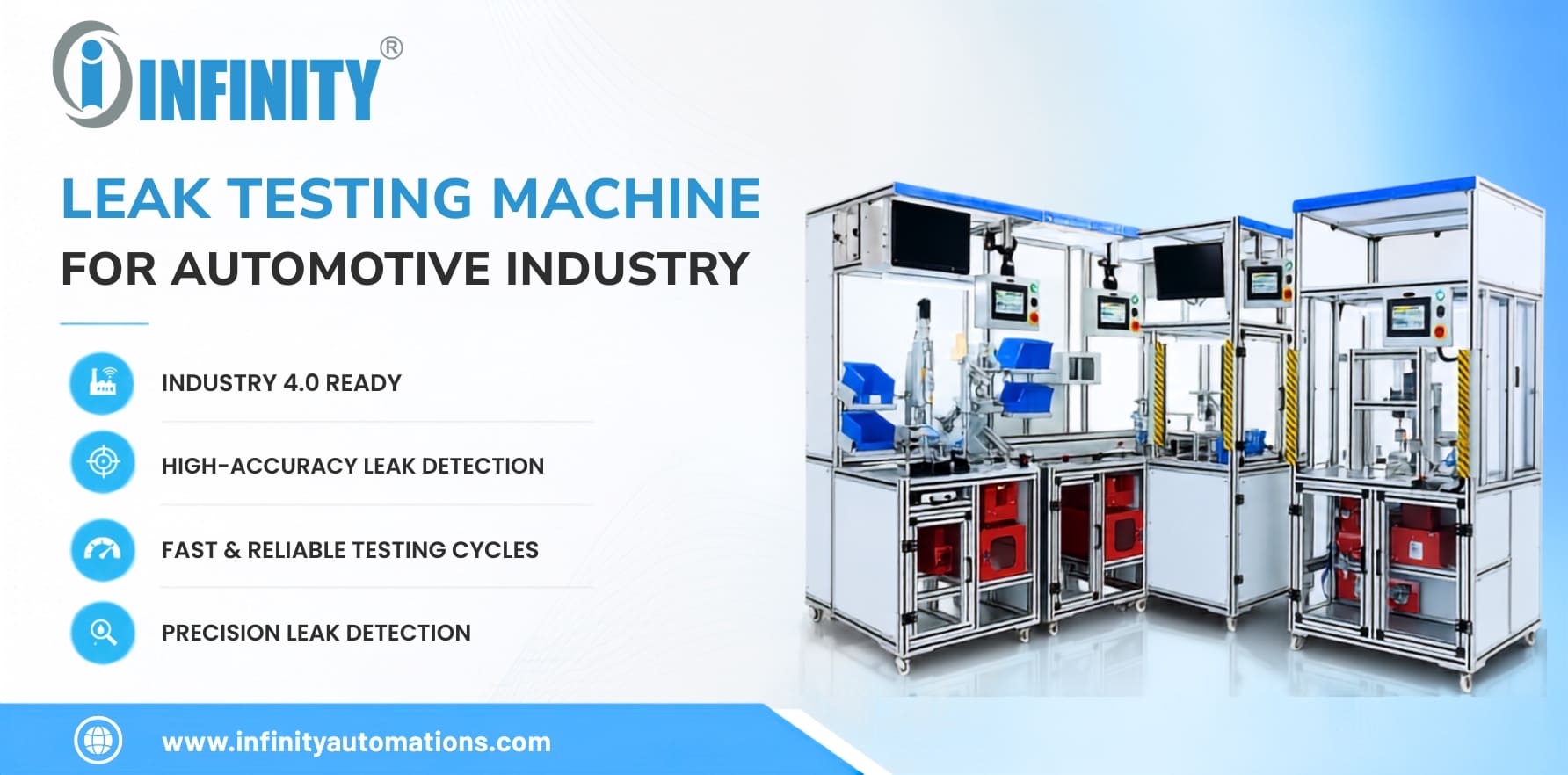
As the automotive sector rapidly embraces Industry 4.0 and electric mobility, leak testing has evolved from a simple inspection process into an intelligent, automated quality control system. Modern leak testing machines integrate with PLCs, Manufacturing Execution Systems (MES), barcode scanners, and real-time data monitoring platforms, enabling complete production traceability and improved manufacturing efficiency.
Whether testing EV battery packs, fuel systems, engine blocks, brake assemblies, or cooling systems, leak testing has become indispensable for delivering safe, reliable, and high-quality vehicles in today's competitive automotive market.
What is a Leak Testing Machine for the Automotive Industry?
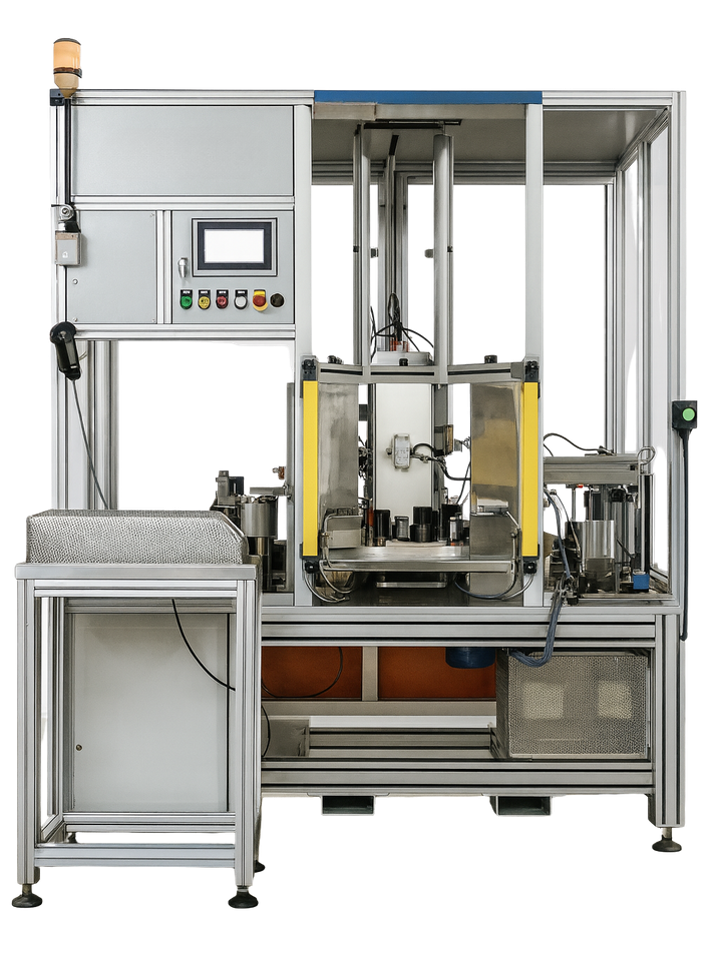
A Leak Testing Machine for Automotive Industry is a specialized quality inspection system designed to detect unwanted leakage in automotive components before they are assembled into a vehicle. The primary objective is to ensure that sealed components can retain air, gas, coolant, fuel, oil, or other fluids within specified limits throughout their intended service life.
Unlike visual inspections, which can only identify surface defects, leak testing machines detect microscopic leaks that are invisible to the human eye. These leaks may occur due to manufacturing defects such as poor welds, casting porosity, damaged seals, faulty gaskets, or improper assembly. Even a tiny leak can lead to reduced vehicle performance, increased emissions, safety risks, and expensive warranty repairs.
The testing process is completely non-destructive. The machine pressurizes or evacuates the component and monitors pressure, airflow, or vacuum changes over a defined period. If the measured values exceed the acceptable leak limits, the component is automatically rejected, ensuring that only quality-approved parts proceed to the next manufacturing stage.
Modern leak testing machines are designed for high-speed production environments and can inspect hundreds or even thousands of components per hour with exceptional repeatability. They are widely used for testing EV battery packs, engine blocks, fuel tanks, brake components, transmission housings, HVAC assemblies, radiators, heat exchangers, electronic enclosures, and other critical automotive parts.
Why Leak Testing is Important in Automotive Manufacturing
Leak testing is much more than a routine quality inspection—it is a vital process that protects vehicle safety, product reliability, manufacturing efficiency, and brand reputation. As automotive systems become increasingly advanced, manufacturers must ensure that every sealed component performs exactly as intended under real-world operating conditions.
One of the primary benefits of leak testing is enhanced passenger safety. Components such as brake systems, fuel lines, battery enclosures, and cooling circuits operate under pressure or contain hazardous fluids. Detecting leaks during production helps prevent failures that could lead to accidents, fires, or system malfunctions.
Leak testing also plays a significant role in reducing warranty claims and recalls. Identifying defective components before shipment prevents costly repairs, product replacements, and customer dissatisfaction. Early defect detection allows manufacturers to improve production quality while minimizing scrap and rework.
Another key advantage is regulatory compliance. Automotive manufacturers must adhere to internationally recognized quality standards such as IATF 16949 and ISO 9001, along with OEM-specific requirements. Automated leak testing provides documented inspection records that support quality audits and complete production traceability.
With the rise of electric vehicles, leak testing has become even more important. EV battery packs require exceptional sealing performance to prevent water, dust, and moisture from entering sensitive electrical components. Reliable leak testing helps manufacturers achieve high ingress protection (IP) ratings while ensuring battery safety and long-term durability.
In today's competitive manufacturing environment, investing in advanced leak testing machines enables automotive companies to improve product reliability, reduce operational costs, maintain customer confidence, and achieve consistent production quality across high-volume manufacturing lines.
Key Automotive Applications of Leak Testing
Modern vehicles contain numerous sealed systems that require leak-free performance throughout their operational life. Leak testing is integrated into multiple stages of automotive manufacturing to ensure that critical components meet strict quality and safety requirements.
1. EV Battery Pack Leak Testing
Electric vehicle battery packs are among the most critical applications for leak testing. Battery enclosures must protect high-voltage cells, electronic control systems, cooling channels, and connectors from water, dust, humidity, and contaminants. Even a microscopic leak can compromise thermal management, reduce battery efficiency, or create significant safety risks.
Manufacturers use advanced leak testing machines to verify the sealing integrity of battery enclosures, cooling plates, cable entry points, vent valves, and complete battery pack assemblies. Automated testing ensures compliance with IP67 and IP68 ingress protection standards while supporting high-volume EV production with complete digital traceability.
2. Fuel System Leak Testing
Although electric vehicles continue to grow in popularity, internal combustion engine vehicles still represent a significant portion of global automotive production. Fuel tanks, fuel rails, injectors, pumps, pressure regulators, and fuel lines must remain completely sealed to prevent fuel leakage, evaporative emissions, and safety hazards.
Leak testing verifies that every fuel system component can withstand operating pressures without leakage. Detecting defects before assembly helps manufacturers improve fuel efficiency, comply with environmental regulations, reduce warranty claims, and enhance vehicle safety.
3. Brake System Leak Testing
The braking system is one of the most safety-critical assemblies in any vehicle. Hydraulic leaks can reduce braking performance, increase stopping distances, or even result in complete brake failure. For this reason, brake components undergo rigorous leak testing before they are installed in vehicles.
Typical components include brake master cylinders, calipers, wheel cylinders, ABS modules, hydraulic valves, hoses, and reservoirs. Automated leak testing machines monitor pressure stability and instantly identify defective components, ensuring that only fully compliant parts move forward in the production process.
4. Engine Component Leak Testing
Engine components operate under extreme temperatures and pressures, making leak-free performance essential for reliability and efficiency. Components such as engine blocks, cylinder heads, intake manifolds, water jackets, oil galleries, turbocharger housings, and oil pumps must maintain complete sealing throughout their service life.
Leak testing helps manufacturers detect casting porosity, machining defects, damaged seals, and assembly issues before components reach the assembly line. Automated testing reduces warranty claims, improves fuel efficiency, and ensures compliance with OEM quality requirements.
5. Cooling System Leak Testing
Modern vehicles rely on efficient cooling systems to regulate engine and battery temperatures. Components such as radiators, condensers, oil coolers, battery cooling plates, heat exchangers, coolant reservoirs, and water pumps must remain leak-free to maintain thermal performance.
Even a small coolant leak can lead to overheating, reduced efficiency, corrosion, and premature component failure. Automotive manufacturers use leak testing machines to verify the integrity of cooling system components before final assembly. This ensures consistent thermal management, improved product reliability, and reduced maintenance costs throughout the vehicle's lifespan.
Common Leak Testing Methods
Selecting the right leak testing technology depends on component design, production volume, acceptable leak rate, and required testing accuracy. Modern automotive manufacturers often use multiple testing methods within the same production line.
1. Pressure Decay Testing
The component is pressurized with compressed air or nitrogen, isolated from the air supply, and monitored for pressure loss over a specified period.
Best suited for: Engine blocks, fuel tanks, brake components, plastic reservoirs, radiators, transmission housings.
Fast Non-destructive High repeatability2. Differential Pressure Testing
Compares the pressure between a leak-free reference chamber and the test component for greater sensitivity and minimized temperature-related errors.
Ideal for: Fuel injectors, brake valves, sensors, battery cooling plates, hydraulic components.
High accuracy Excellent repeatability Faster cycles3. Vacuum Decay Testing
Removes air from the component or test chamber and monitors changes in vacuum over time. Effective for lightweight or flexible parts.
Common applications: EV battery enclosures, electronic housings, plastic components, brake reservoirs.
High sensitivity Suitable for delicate parts Non-destructive4. Helium Leak Testing
One of the most precise leak detection methods using helium as a tracer gas and a mass spectrometer for detection.
Commonly used for: EV battery packs, hydrogen fuel systems, refrigerant circuits, high-value assemblies.
Ultra-precise Validation & R&D Safety-critical5. Mass Flow Testing
Measures the actual quantity of gas passing through a leak rather than inferring leakage from pressure changes.
Applications: HVAC systems, heat exchangers, cooling circuits, radiators, air intake systems.
Quantitative Less affected by temperature Automated productionHow to Choose the Right Leak Testing Machine
Selecting the right leak testing machine is essential for achieving reliable quality control and maximizing production efficiency. The ideal system should match the component being tested, required leak sensitivity, production speed, and future automation requirements.
- Component Type: Battery packs, engine blocks, fuel systems, cooling plates, and electronic sensors each require different testing methods.
- Leak Detection Sensitivity: Choose equipment capable of detecting the leak rates specified by OEM quality standards without causing excessive false rejections.
- Production Volume: Manual or semi-automatic systems are suitable for prototypes and small batches, while high-volume manufacturing requires fully automated inline inspection.
- Cycle Time: Faster testing supports higher production throughput without compromising accuracy.
- Automation Compatibility: Ensure the system integrates with PLCs, robotic handling systems, MES platforms, barcode scanners, and Industry 4.0 infrastructure.
- Data Traceability: Modern machines should record pressure, leak rate, operator information, timestamps, and pass/fail results for complete production traceability.
- Maintenance & Service: Easy calibration, remote diagnostics, spare parts availability, and strong technical support reduce downtime and improve long-term reliability.
Rather than focusing solely on equipment cost, manufacturers should evaluate the total cost of ownership (TCO). A high-quality leak testing machine reduces scrap, minimizes warranty claims, improves first-pass yield, and delivers a strong return on investment over its operational life.
Industry 4.0 & Automation
Automotive manufacturing is rapidly embracing Industry 4.0, making leak testing more intelligent, connected, and data-driven than ever before. Modern leak testing machines no longer perform only pass/fail inspections—they also collect production data, communicate with factory systems, and support predictive maintenance.
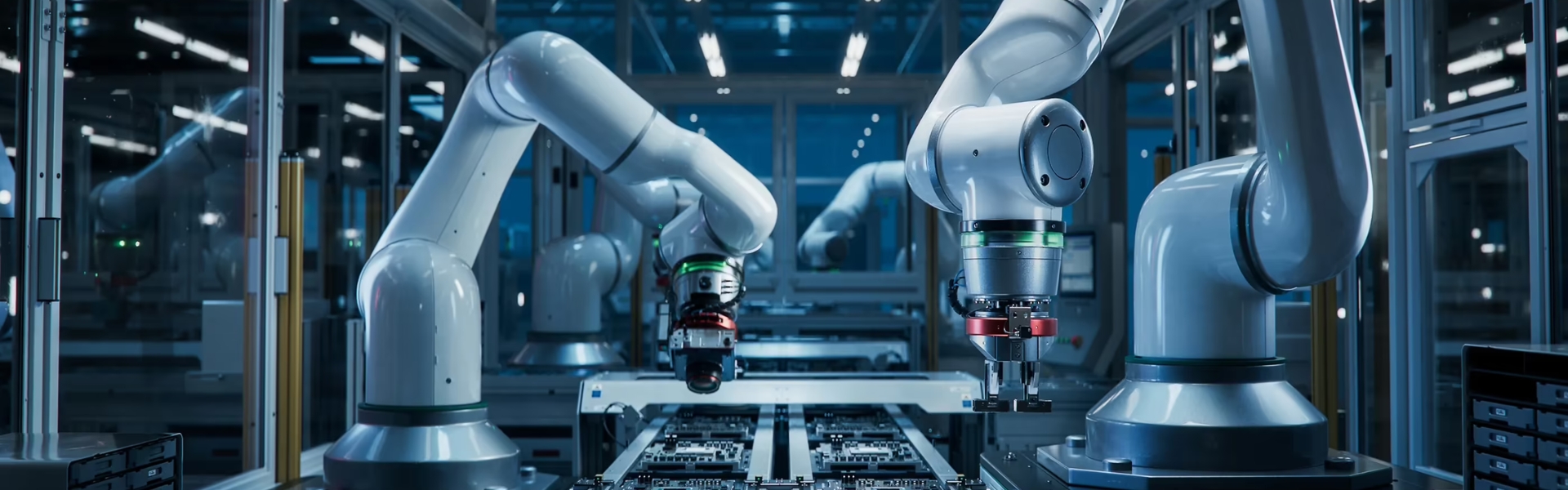
Automated leak testing stations integrate seamlessly with PLCs, MES platforms, conveyor systems, robotic loading units, barcode scanners, and vision inspection systems. This enables automatic test parameter selection, real-time quality monitoring, digital traceability, and immediate rejection of defective components.
Manufacturers benefit from:
- Faster inspection cycles
- Reduced operator dependency
- Improved repeatability
- Higher production throughput
- Lower labor costs
- Complete quality documentation
- Predictive maintenance capabilities
By combining leak testing with automation, manufacturers improve operational efficiency while maintaining consistent product quality across high-volume production lines. Industry 4.0 integration also provides valuable production insights that support continuous process improvement and smarter manufacturing decisions.
Conclusion
Leak testing has become an indispensable quality assurance process in modern automotive manufacturing. From EV battery packs and engine components to brake systems, cooling assemblies, and fuel systems, every sealed component must perform reliably throughout its service life.
By implementing advanced leak testing technologies such as Pressure Decay, Differential Pressure, Vacuum Decay, Helium, and Mass Flow Testing, manufacturers can improve product quality, reduce warranty claims, enhance safety, and meet global automotive quality standards.
As Industry 4.0 continues to reshape manufacturing, intelligent leak testing systems provide the automation, traceability, and data-driven insights needed for future-ready production.
Infinity Automations delivers advanced leak testing solutions tailored to the automotive industry. Whether you require high-speed inline inspection, EV battery leak testing, or fully automated quality control systems, our experts can help you select the right solution for your manufacturing requirements.
Looking for a Leak Testing Machine for the Automotive Industry?
Discover Infinity Automation Systems' advanced leak testing solutions for reliable quality inspection and production efficiency.
Contact Infinity Automation →Frequently Asked Questions (FAQs)
A leak testing machine detects leaks in automotive components such as EV battery packs, fuel tanks, engines, brake systems, and cooling assemblies before production.
Pressure Decay Testing is the most commonly used leak testing method in automotive manufacturing due to its speed, accuracy, and suitability for automated production lines.
Leak testing prevents water and dust ingress, ensuring battery safety, thermal management, and compliance with IP67/IP68 protection standards.
Automotive OEMs, Tier-1 suppliers, EV manufacturers, component manufacturers, and industrial automation companies.
They reduce manual inspection, improve traceability, increase production speed, and provide consistent quality control through Industry 4.0 integration.