Plastic Welding Machine Guide: Types, Technologies, Advantages & Applications
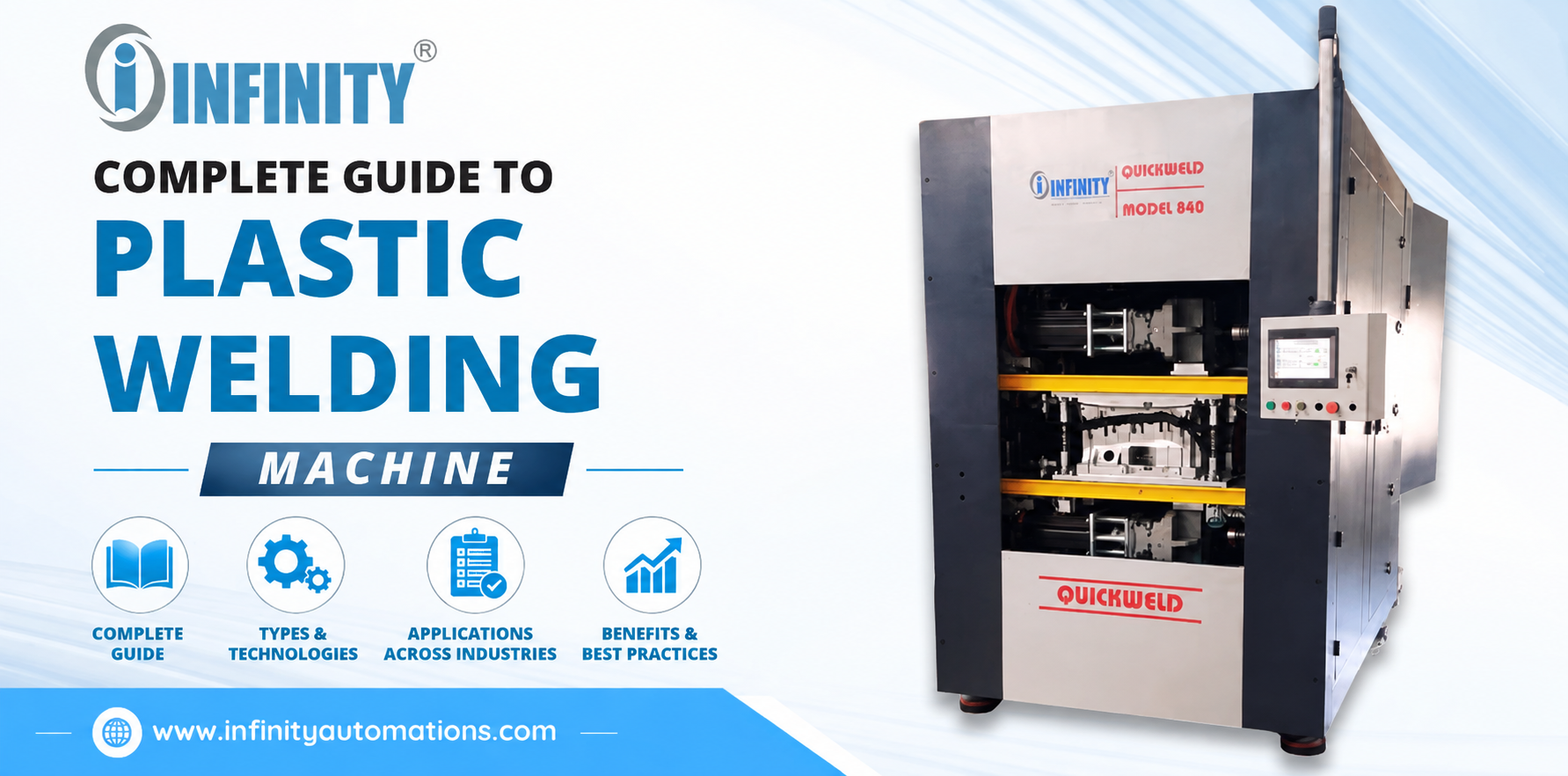
Plastic has become one of the most widely used engineering materials across industries due to its lightweight nature, corrosion resistance, design flexibility, and cost-effectiveness. From automotive fuel tanks and medical devices to consumer electronics and industrial equipment, plastic components are now essential in modern manufacturing.
However, assembling plastic parts requires more than just adhesives or screws. Manufacturers increasingly rely on Plastic Welding to create permanent, strong, leak-proof, and high-quality joints. Plastic welding technologies enable two thermoplastic components to fuse at a molecular level, resulting in durable assemblies that often outperform mechanical fastening methods.
Today, several Plastic Welding Technologies are available, each designed to meet different production requirements. Whether you need to weld large industrial parts, miniature medical devices, automotive components, or precision electronic housings, selecting the right welding process is crucial for achieving optimal quality, efficiency, and cost savings.
This comprehensive guide explains the most popular Plastic Welding Technologies, including Hot Plate Welding, Ultrasonic Welding, Spin Welding, Vibration Welding, and Laser Plastic Welding, along with their working principles, advantages, limitations, applications, and selection criteria.
What is Plastic Welding?

Plastic Welding is a manufacturing process used to permanently join two or more thermoplastic components by applying controlled heat, pressure, friction, vibration, or laser energy. Unlike adhesives or mechanical fasteners, plastic welding melts the material at the joint interface, allowing the polymers to fuse together. Once cooled, the welded joint becomes an integral part of the component.
The process offers numerous benefits, including:
- Strong molecular bonding
- Leak-proof joints
- Improved structural integrity
- Faster production cycles
- Reduced assembly costs
- Cleaner product appearance
- Enhanced product durability
Plastic welding is widely used across industries where precision, reliability, and repeatability are essential.
Why Plastic Welding is Preferred Over Traditional Joining Methods
Compared to gluing, riveting, or screwing, plastic welding offers several manufacturing advantages.
- Stronger Joints – Welded parts form a molecular bond rather than relying on external materials or hardware, resulting in higher joint strength.
- Leak-Proof Sealing – Many welding processes create hermetic seals suitable for tanks, medical devices, fluid reservoirs, and automotive components.
- Lower Manufacturing Cost – Eliminating adhesives, screws, inserts, and additional assembly operations reduces production costs.
- Better Product Appearance – Plastic welding produces clean, seamless joints without visible fasteners.
- Faster Production – Many welding technologies support automated, high-speed manufacturing.
How Plastic Welding Works
Although each welding technology differs, most follow a similar sequence:
- Plastic components are positioned in fixtures.
- Heat or friction is applied to the joining surfaces.
- The plastic softens or melts.
- Pressure joins the components.
- The material cools under controlled conditions.
- A permanent weld is formed.
The quality of the weld depends on:
- Material compatibility
- Temperature control
- Pressure
- Welding time
- Cooling cycle
- Tooling accuracy
Different Plastic Welding Technologies
Several welding technologies are available, each designed for specific applications and materials.
1. Hot Plate Welding
What is Hot Plate Welding? Hot Plate Welding joins thermoplastic components using a heated metal plate positioned between the parts. The contact surfaces are heated until they become molten. The heated plate is then removed, and the components are pressed together to form a permanent bond.
Suitable Materials: Polypropylene (PP), Polyethylene (PE), HDPE, Nylon (PA), ABS, PVC, PC, PBT.
Advantages: Excellent weld strength, leak-proof joints, ideal for large components, handles thick-walled parts, lower tooling cost, consistent weld quality, suitable for automation.
Limitations: Longer cycle times, heated plate requires maintenance, larger machine footprint, not ideal for miniature precision parts.
Common Applications: Automotive fuel tanks, water tanks, battery housings, HVAC ducts, industrial containers, agricultural equipment, medical reservoirs.
Large Parts Leak-Proof High Strength2. Ultrasonic Welding
What is Ultrasonic Welding? Ultrasonic Welding uses high-frequency mechanical vibrations to generate localized frictional heat between plastic components. The process melts the interface within milliseconds, producing a strong joint without external heating.
Advantages: Extremely fast, high precision, clean process, excellent cosmetic finish, low energy consumption, easy automation.
Limitations: Higher machine cost, limited part size, requires precise joint design, tool wear over time.
Common Applications: Medical devices, electrical connectors, automotive sensors, consumer electronics, packaging, toys, small plastic assemblies.
Fast Precision Clean3. Spin Welding
What is Spin Welding? Spin Welding joins circular plastic components by rotating one part against another under pressure. Friction generates heat, melting the contact surfaces and creating a strong weld.
Advantages: Strong circular welds, fast production, low operating cost, reliable process, excellent joint strength.
Limitations: Limited to circular parts, not suitable for irregular geometries, requires rotational symmetry.
Applications: Fluid reservoirs, automotive filters, pipe fittings, water pumps, bottle caps, valve assemblies.
Circular Parts Fast Cost-Effective4. Vibration Welding
What is Vibration Welding? Vibration Welding generates frictional heat by moving one plastic component against another using controlled linear vibrations. This technology is ideal for joining large, irregularly shaped plastic components.
Advantages: Suitable for large parts, high structural strength, leak-proof joints, fast cycle times, excellent repeatability.
Limitations: Larger machine size, generates vibration noise, higher tooling costs.
Applications: Automotive dashboards, air intake manifolds, instrument panels, battery cases, industrial housings.
Large Parts High Strength Fast5. Laser Plastic Welding
What is Laser Plastic Welding? Laser Plastic Welding joins plastics using a focused laser beam that passes through one transparent component and melts the absorbing component beneath it. The process creates highly precise, clean, and aesthetically pleasing welds.
Advantages: Extremely precise, no physical contact, clean appearance, minimal contamination, excellent automation capability.
Limitations: Higher equipment cost, material compatibility requirements, transparent/absorbing material combinations needed.
Applications: Medical devices, automotive sensors, electronics, optical components, battery modules, wearable devices.
Ultra-Precision Clean AutomationComparison of Plastic Welding Technologies
| Technology | Heat Source | Speed | Precision | Large Parts | Thick Parts | Automation |
|---|---|---|---|---|---|---|
| Hot Plate Welding | Heated Plate | Medium | High | Excellent | Excellent | Excellent |
| Ultrasonic Welding | High-Frequency Vibration | Very Fast | Very High | Limited | Limited | Excellent |
| Spin Welding | Rotational Friction | Fast | High | Circular Only | Moderate | Good |
| Vibration Welding | Linear Friction | Fast | High | Excellent | Excellent | Excellent |
| Laser Plastic Welding | Laser Beam | Fast | Extremely High | Limited | Thin to Medium | Excellent |
Advantages of Plastic Welding Technologies
Regardless of the process selected, Plastic Welding Technologies provide several manufacturing benefits.
Plastic welding creates molecular fusion rather than mechanical attachment.
Ideal for tanks, reservoirs, medical equipment, and fluid-handling systems.
Lower assembly costs by eliminating adhesives and fasteners.
Consistent welds reduce defects and improve reliability.
Many technologies support fully automated production lines.
No visible screws or glue lines improve product aesthetics.
Limitations of Plastic Welding
Although highly effective, plastic welding also has some limitations.
- Material compatibility is essential.
- Initial equipment investment can be significant.
- Some technologies require specialized tooling.
- Operator training is necessary.
- Joint design influences weld quality.
- Different plastics require different welding methods.
Industry Applications
Plastic welding has become indispensable across various industries.
Automotive
Applications include: Fuel tanks, battery housings, air ducts, lighting assemblies, filters, fluid reservoirs.
Medical Industry
Manufacturers use plastic welding for: IV connectors, diagnostic cartridges, surgical instruments, medical filters, drug delivery devices.
Consumer Electronics
Used for: Mobile devices, laptop housings, remote controls, smart devices, wearables.
Packaging Industry
Applications include: Food containers, cosmetic packaging, pharmaceutical packaging, sealed pouches, caps and closures.
Industrial Equipment
Plastic welding is widely used in: Chemical storage tanks, water treatment systems, electrical enclosures, agricultural machinery, industrial piping.
How to Choose the Right Plastic Welding Technology
Selecting the right welding process depends on several critical factors.
- Material Type – Different thermoplastics respond differently to various welding methods.
- Product Size – Large products generally require Hot Plate or Vibration Welding, while small precision components are better suited to Ultrasonic or Laser Welding.
- Production Volume – High-volume manufacturing often benefits from Ultrasonic and Laser Welding due to their fast cycle times.
- Joint Strength – Structural applications requiring maximum strength typically favor Hot Plate or Vibration Welding.
- Leak-Proof Requirements – For tanks, reservoirs, and fluid-handling components, Hot Plate Welding is often the preferred choice.
- Budget – Consider initial machine cost, tooling investment, operating expenses, maintenance requirements, and expected production volume.
Future Trends in Plastic Welding Technologies
The industry continues to evolve with advancements in smart manufacturing.
- Industry 4.0 integration
- PLC and servo-controlled systems
- AI-assisted process optimization
- Robotic welding cells
- Vision inspection systems
- IoT-enabled monitoring
- Predictive maintenance
- Digital production analytics
- Energy-efficient welding systems
Looking for the Right Plastic Welding Machine?
Contact Infinity Automation Systems today to discuss your application requirements. Our engineering team will help you select the right welding technology and automation solution for your manufacturing needs.
Contact Infinity Automation Systems →Conclusion
Plastic Welding has transformed modern manufacturing by providing reliable, efficient, and cost-effective methods for joining thermoplastic components. From heavy-duty industrial tanks to miniature medical devices, different Plastic Welding Technologies address a wide range of production requirements.
Processes such as Hot Plate Welding, Ultrasonic Welding, Spin Welding, Vibration Welding, and Laser Plastic Welding each offer unique strengths in terms of speed, precision, material compatibility, and application suitability. Understanding these differences enables manufacturers to select the most appropriate solution for their specific products, production volumes, and performance expectations.
By carefully evaluating factors such as material type, component geometry, joint strength, automation needs, and budget, businesses can improve product quality, reduce manufacturing costs, and enhance operational efficiency. As smart manufacturing and Industry 4.0 continue to evolve, plastic welding technologies will remain at the forefront of innovation, helping industries produce stronger, lighter, and more sustainable products.
Frequently Asked Questions (FAQs)
Plastic welding is a manufacturing process that permanently joins thermoplastic components using heat, pressure, friction, vibration, or laser energy to create strong molecular bonds.
The best technology depends on the application. Hot Plate Welding is ideal for large, leak-proof components, Ultrasonic Welding suits precision parts, Spin Welding is best for circular components, Vibration Welding handles large irregular assemblies, and Laser Plastic Welding offers exceptional precision for advanced applications.
Ultrasonic Welding is generally the fastest, with cycle times often below two seconds.
Hot Plate Welding and Vibration Welding typically deliver the highest structural strength for large and thick plastic components.
Yes. Most modern Plastic Welding Technologies can be integrated into automated production lines using PLCs, robotics, and vision systems for consistent, high-volume manufacturing.