Leak Testing Machine for EV Battery Manufacturing
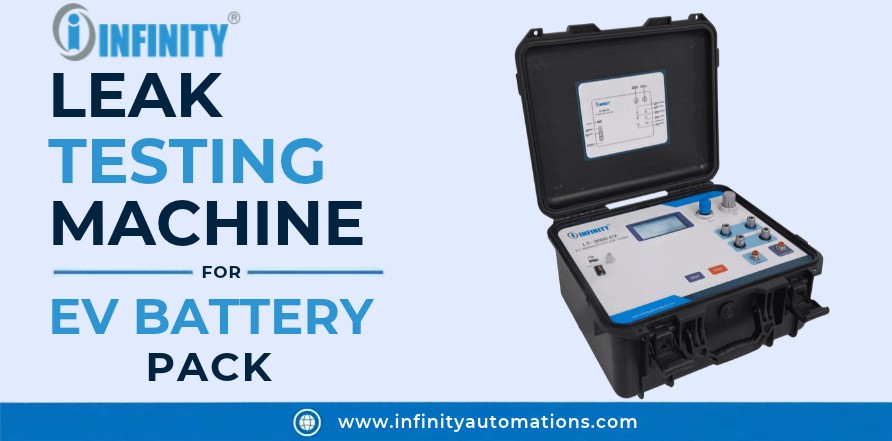
A Leak Testing Machine for EV Battery Manufacturing is an automated inspection system designed to evaluate the sealing integrity of battery components and complete battery packs. Using methods such as Pressure Decay Leak Testing, it helps identify potential leakage points in battery enclosures, cooling plates, cooling circuits, modules, connector assemblies, and complete battery systems.
The electric vehicle (EV) industry is experiencing unprecedented growth, driven by increasing environmental awareness, government incentives, and rapid advancements in battery technology. At the heart of every electric vehicle lies the battery pack—a highly engineered system responsible for storing and delivering energy safely and efficiently.
An EV battery pack is continuously exposed to harsh operating conditions, including vibration, thermal cycling, moisture, dust, road debris, and varying environmental temperatures. Even a microscopic leak within the battery housing or cooling system can lead to moisture ingress, corrosion, electrical failures, reduced battery life, thermal runaway, or safety hazards.
For this reason, Leak Testing Machines for EV Battery Manufacturing have become an essential part of modern battery production lines. By accurately detecting leaks before batteries leave the factory, manufacturers can ensure compliance with quality standards, improve product reliability, reduce warranty claims, and enhance customer safety.
This guide explores the importance of EV Battery Leak Testing, explains the Pressure Decay Leak Testing process, discusses industry challenges, highlights applicable standards, and demonstrates why investing in a modern Battery Leak Testing Machine is critical for today's EV manufacturers.
Why Leak Testing is Critical for EV Batteries
Electric vehicle battery packs are designed to protect sensitive lithium-ion cells and electronic components throughout the vehicle's life. They must prevent the ingress of water, dust, humidity, and contaminants while maintaining structural integrity under demanding operating conditions.
Even extremely small leaks can cause moisture ingress into battery modules, corrosion of electrical connections, reduced insulation resistance, cooling system leakage, battery performance degradation, premature component failure, increased warranty costs, thermal runaway risks, and reduced vehicle safety.
A high-precision Leak Testing Machine helps manufacturers detect these defects before the battery pack is assembled into the vehicle.
Understanding EV Battery Pack Manufacturing
An EV battery pack consists of several interconnected systems working together.
Typical components include:
- Battery cells
- Battery modules
- Battery pack enclosure
- Cooling plates
- Cooling channels
- Busbars
- Battery Management System (BMS)
- High-voltage connectors
- Sealing gaskets
- Pressure equalization vents
Each of these components may require leak testing during different stages of production.
Why Battery Pack Leak Testing is Essential
Modern battery packs are designed to achieve high Ingress Protection (IP) ratings such as IP67, IP68, and IP69K (application dependent). These ratings require the battery enclosure to resist water and dust intrusion under demanding conditions.
Leak testing verifies that welds are properly sealed, gaskets are correctly installed, cooling circuits are leak-free, housing integrity meets design specifications, and assembly defects are detected before shipment.
Without proper Battery Pack Leak Testing, defects may remain undetected until vehicles are in service.
What is a Battery Leak Testing Machine?
A Battery Leak Testing Machine is an automated inspection system designed to evaluate the sealing integrity of battery components and complete battery packs.
Depending on the application, the system may test battery housings, cooling plates, battery modules, battery pack enclosures, cooling circuits, busbar compartments, vent assemblies, and connector interfaces.
Modern systems use advanced technologies such as Pressure Decay Leak Testing, Differential Pressure Testing, Flow Testing, and Vacuum Leak Testing for specific applications.
Pressure Decay Leak Testing Explained
Pressure Decay Leak Testing is one of the most widely used methods for EV battery manufacturing.
Working Principle: The component under test is sealed and pressurized using clean compressed air.
The testing sequence typically includes:
- Component loading
- Fixture sealing
- Pressurization
- Stabilization
- Pressure measurement
- Leak rate calculation
- Pass/fail evaluation
- Venting
- Product unloading
If pressure decreases beyond the allowable limit during the test period, the component is identified as leaking.
Why Pressure Decay Testing?
Pressure Decay Testing offers several advantages:
- High accuracy
- Non-destructive testing
- Fast cycle times
- Excellent repeatability
- Easy automation
- Suitable for mass production
- Digital data recording
It is particularly effective for rigid battery housings and cooling assemblies.
EV Battery Leak Testing Process
A typical automated leak testing cycle includes:
Step 1: Component Loading
Battery components are loaded manually or by robotic systems into a custom fixture.
Step 2: Fixture Sealing
The fixture seals all ports and openings to isolate the test volume.
Step 3: Pressurization
Compressed air is introduced until the target pressure is achieved.
Step 4: Stabilization
Pressure is allowed to stabilize to eliminate thermal and mechanical effects.
Step 5: Leak Measurement
Precision sensors measure pressure decay over a predefined period.
Step 6: Pass/Fail Decision
Software compares measured values with programmed acceptance limits.
Step 7: Data Recording
Production data is stored automatically for traceability. Typical records include leak rate, test pressure, cycle time, part ID, operator ID, date and time, and pass/fail result.
Components Commonly Tested
Leak testing is performed on numerous battery system components.
Battery Pack Enclosures
Ensure protection against water and dust ingress.
Cooling Plates
Verify coolant channels remain leak-free.
Cooling Circuits
Prevent coolant leakage during vehicle operation.
Battery Modules
Confirm assembly integrity before pack integration.
Connector Assemblies
Protect electrical interfaces from environmental contamination.
Pressure Equalization Systems
Ensure vents perform correctly while maintaining enclosure integrity.
Industry Standards
Battery leak testing supports compliance with several industry standards and customer-specific requirements.
Commonly referenced standards include:
IP Protection Ratings
IP67, IP68, and IP69K (where applicable) define resistance to water and dust ingress.
ISO 9001
Quality Management Systems for manufacturing.
IATF 16949
Automotive Quality Management System standard emphasizing process control and defect prevention.
OEM Specifications
Automotive manufacturers often define leak-rate limits, test pressures, and acceptance criteria specific to their battery designs.
Challenges in EV Battery Leak Testing
Battery manufacturing presents several technical challenges.
- Large Test Volumes: Battery packs often contain significant internal volumes, requiring highly sensitive measurement systems.
- Complex Geometries: Multiple seals, welds, and compartments increase testing complexity.
- Tight Leak Limits: EV battery systems frequently require detection of extremely small leaks.
- High Production Rates: Manufacturers need rapid testing without compromising accuracy.
- Temperature Effects: Pressure measurements can be influenced by thermal changes during testing.
- Fixture Design: Proper fixture sealing is essential for repeatable results.
Benefits of Automated Leak Testing
Modern Leak Testing Machines deliver significant manufacturing advantages.
Detect defects before final assembly.
Reduce the risk of moisture ingress and electrical failures.
Short cycle times support high-volume manufacturing.
Prevent defective battery packs from reaching customers.
Automatic data logging supports quality audits and process improvement.
Automation minimizes operator influence and ensures reliable measurements.
Systems can integrate with PLCs, robots, MES, SCADA, barcode readers, and vision inspection systems.
Explore Leak Testing Solutions
Case Study: Improving Leak Detection in EV Battery Production
Customer Challenge: An EV battery manufacturer experienced intermittent water ingress during environmental testing. Investigation revealed inconsistent sealing of battery pack enclosures, leading to product rework and increased warranty risk.
Solution: The manufacturer implemented a fully automated Pressure Decay Leak Testing system with custom leak-proof fixtures, high-resolution pressure sensors, PLC-controlled testing cycles, automatic barcode scanning, digital traceability, and pass/fail sorting.
Results: Improved leak detection accuracy, reduced false failures, faster inspection cycles, better process consistency, lower rework costs, enhanced customer confidence, and full production traceability.
How to Select the Right Leak Testing Machine
When choosing a Leak Testing Machine for EV Battery Manufacturing, consider:
- Product Type: Battery housing, module, cooling plate, or complete battery pack.
- Required Leak Sensitivity: Select equipment capable of meeting your specified leak-rate limits.
- Production Volume: Ensure the system supports required cycle times.
- Automation Requirements: Consider robotic loading, conveyor integration, and production monitoring.
- Traceability: Look for systems that automatically record production and quality data.
- Scalability: Choose equipment that can adapt to future battery designs and manufacturing requirements.
Why Choose Infinity Automation Systems?
Infinity Automation Systems Private Limited specializes in advanced leak testing and industrial automation solutions designed for high-precision manufacturing. Our EV battery leak testing solutions are engineered to deliver exceptional accuracy, repeatability, and seamless integration with modern production lines.
Our capabilities include:
- Custom Leak Testing Machines
- Pressure Decay Leak Testing Systems
- Automated Testing Stations
- PLC & HMI-Based Controls
- Robotic Integration
- Data Logging & Traceability
- Industry 4.0 Ready Solutions
- Custom Fixtures for EV Battery Components
Whether you manufacture battery modules, cooling plates, or complete battery packs, our solutions are designed to improve quality, productivity, and operational efficiency.
Looking for an EV Battery Leak Testing Solution?
Talk to Infinity Automation Systems about customized leak testing solutions for battery modules, battery packs, cooling plates and cooling circuits.
Request a Technical Consultation → Explore EV Battery Pack Leak Tester →Conclusion
As electric vehicle adoption accelerates worldwide, ensuring the safety and reliability of battery systems has become a top priority for manufacturers. A high-performance Leak Testing Machine for EV Battery Manufacturing is essential for detecting microscopic leaks that could compromise battery performance, reduce service life, or create safety risks.
Among the available technologies, Pressure Decay Leak Testing remains one of the most effective solutions for Battery Pack Leak Testing due to its high accuracy, non-destructive operation, fast cycle times, and compatibility with automated production lines. By integrating advanced Battery Leak Testing Machines into manufacturing processes, companies can improve product quality, reduce warranty claims, ensure compliance with automotive quality standards, and maintain complete production traceability.
Investing in a reliable leak testing solution not only protects the integrity of EV batteries but also supports long-term manufacturing excellence, customer satisfaction, and confidence in next-generation electric mobility.
Contact Infinity Automation Systems to discuss your EV battery leak testing requirements.
Frequently Asked Questions (FAQs)
Leak testing ensures battery packs remain protected against water, dust, and contaminants, improving safety, reliability, and product life.
Pressure Decay Leak Testing pressurizes a sealed component and measures pressure loss over time to detect leaks.
Battery housings, cooling plates, cooling circuits, battery modules, connector assemblies, and complete battery packs are commonly tested.
No. Modern Pressure Decay Leak Testing is a non-destructive method suitable for production environments.
Yes. Modern Battery Leak Testing Machines can integrate with PLCs, robots, MES systems, barcode scanners, and automated production lines.
Battery pack enclosures, battery modules, cooling plates, cooling circuits, connector assemblies, and pressure equalization systems can be evaluated using appropriate leak testing methods.
Manufacturers should consider the component being tested, required leak sensitivity, production volume, automation requirements, traceability needs, fixture design, and future scalability.
Yes. Automated systems can record parameters such as leak rate, test pressure, cycle time, part ID, operator ID, date, time, and pass/fail results.
A properly designed fixture isolates the test volume and seals openings consistently, helping improve measurement repeatability and reduce testing errors.
Yes. Pressure Decay Leak Testing is suitable for mass production because of its accuracy, repeatability, fast cycle times, automation compatibility, and digital data recording.